Dr. Mudassar Altaf, Associate Professor of Chemistry, Department of Higher Education, Government of the Punjab, Pakistan
Contents:
- Corrosion: Definition
- Iron versus steel
- Conditions necessary for rusting of iron & steel
- Barrier methods & definition to prevent from rusting
- Reactivity series & corrosion
- Sacrificial protection: Definition
- Galvanization: Definition & example of Zn/Fe
Corrosion: Definition
It can be defined as, “a slow chemical change in which the metal reacts with atmospheric oxygen and moisture to form metallic oxide”.
Iron versus Steel:
The pure form of element is called iron; on the other hand, the alloy of iron when mixed with carbon is called steel. One of the forms of steel is rust free and is called stainless steel; otherwise, many other forms are not rust free.
Conditions Necessary for Rusting of Iron & Steel:
Iron or steel gets corrosion in the presence of:
- Atmospheric oxygen
- Moisture
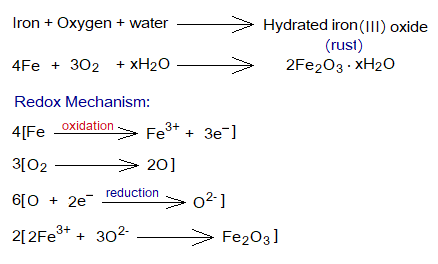
There is a chemical reaction that takes place between iron, oxygen and water to form hydrated iron(III) oxide, called rust (corrosion). The rust is chemically the ferric oxide with water of crystallization. The hydrated substances carry water of crystallization in their molecules, study the hydrated substances from the link salts their preparation.
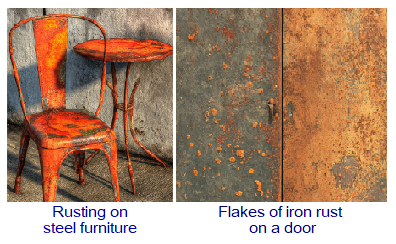
The ferric is cationic iron having oxidation state +3. It is written as iron(III) or Fe+3; for the understanding of use of Roman Numerals, click on the link redox reactions. The rust is in the form of reddish-brown flakes; and unlike aluminum the iron rust doesn’t provide protection as a cover over the surface, rather the metal wears away gradually.
Rusting is a redox mechanism, where iron shows oxidation to generate cations; and oxygen shows reduction to generate anions. Thereafter, the metallic cations and non-metallic anions form an ionic bond of the rust, the metallic oxide.
Barrier Methods to Prevent from Rusting:
Definition: “The methods that can prevent the metal from rusting by blocking oxygen and moisture reaching the surface” are called barrier methods. Examples include:
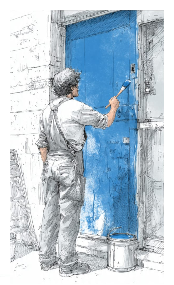
- Painting: The paint layer protects the metal from rusting. The paints give durable, hard and glossy finish. Thus, not only the protection, but also the decoration by paint is also the purpose of colouring the metal.
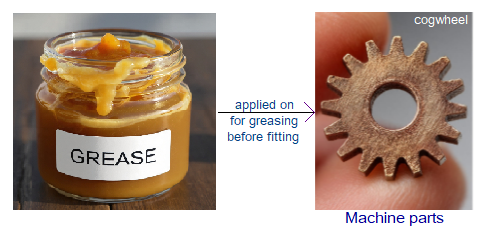
- Greasing: It is a thick paste type oily lubricant that is used to apply on the machine and engine parts to prevent them from corrosion. This lubrication also helps the machine parts to work friction free; otherwise, the rust enhances the friction.
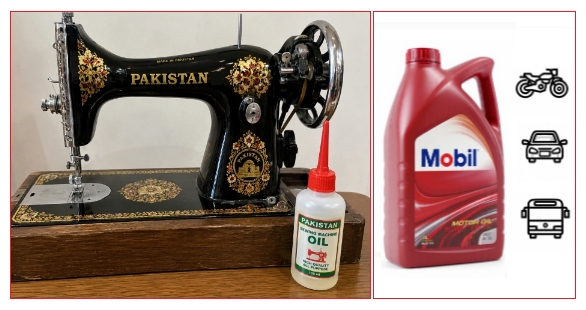
- Oiling: The oil prevents the parts of a machine. For example, sewing machine oil, mobil oil for bikes, cars and other vehicles. Many other examples are there, like door hinges, padlocks are given oil for lubrication and smooth frictionless working. The oiling also helps the machine parts to work by reducing friction; as the grease does its job. Otherwise, the rusting appears and causes the abrasion.
- Plastic Coating / Covering: For prevention from oxygen, water or any other chemical, the electrical insulation of wires, tools, devices can protect them from scratching and wear. The metals’ surfaces are coated or covered with plastic layers for protection against rust as well as decoration. The example includes:
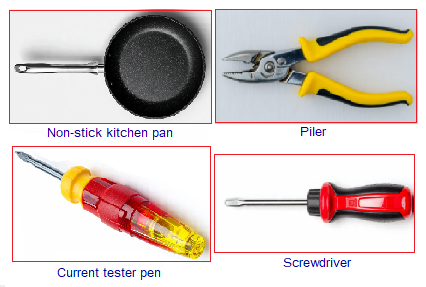
- The surface of the kitchen pans for cooking is coated with polytetrafluoroethylene (PTFE) to make them non-stick.
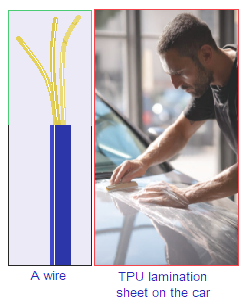
- The conductors of electric wires are sheathed by one of the polymers named the polyvinyl chloride (PVC).
- Thermoplastic polyurethane (TPU) is used as a covering sheet on cars and bikes to protect them from dust, moisture, scratching, paint removal, and inner metal body protection.
- The PVC is also used in metallic hand-tools, such as screwdriver, electrical tester pen, piler, wrench etc. to make their grip easy for the workers, and to protect from electric shocks.
Reactivity Series & Corrosion:
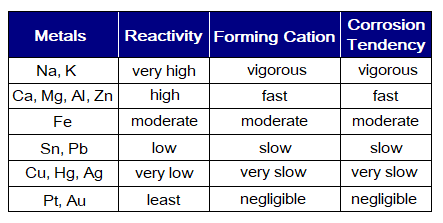
The reactivity series of metals, given below, helps to understand a comparison between metals related to various concepts including their tendency towards corrosion.

This series explains that:
- The more reactive metals, like K, Na etc. have their higher tendencies towards oxidation. In other words, the more reactive metals remove electrons easily from outermost shell for making cations [M→M++e–]. Hence, their nature is more electropositive.
- The more reactive metals have greater tendency to corrode.
Sacrificial Protection:
Definition: “It is a method, by which a more reactive metal is connected to a less reactive metal for protection against rusting; as the more reactive one corrodes and thus sacrifices for less reactive one”.
Zinc is more reactive to iron according to reactivity series. Thus, zinc shows oxidation prior to iron. The zinc sacrifices by getting corrosion rather than iron. Hence, iron remains safe from rusting.

Galvanization:
Definition: “It is a method, by which a more reactive metal is coated on a less reactive metal as a thin layer to protect the inner one from corrosion”. A thin layer of zinc is coated over iron; so, a sacrificial protection keeps the iron safe from rusting.
Fascinating Information:
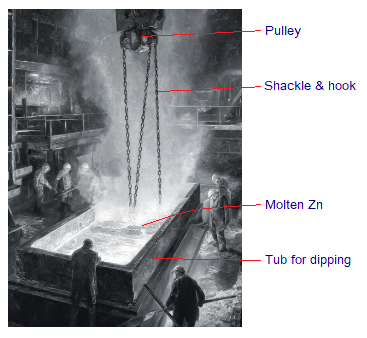
The layer of zinc is coated by a hot-dip method of galvanization by which the iron is dipped into a hot liquid of zinc in a tub. The melting point of zinc is 419.5°C; while that of iron is 1538°C. The molten zinc is just like a mercury liquid in its look; a silvery shinning liquid. The temperature of the molten zinc is adjusted at 450°C. The iron article is submerged into this liquid until it attains the temperature of that hot liquid; and it attains in 4 to 10 minutes depending upon the article size and thickness. Then, it is taken out with the help of pulley.
The name, ‘galvanization’ was given on the name of an Italian pioneer of bioelectricity scientist Luigi Galvani (1737-1798).