Dr. Mudassar Altaf, Associate Professor of Chemistry, Department of Higher Education, Government of the Punjab, Pakistan
Contents:
- Alloy: Definition and etymology
- Properties that are enhanced
- Brass versus bronze
- Stainless steel
- Structure of an alloy that enhance the properties of metals
- Uses of alloys
Alloys: Definition
It is defined as, “the homogeneous mixture of two or more elements, having at least one metal to improve properties of the metal.” The origin of the term ‘alloy’ is Old French word ‘allier’ meaning ‘to join, to assemble, to bind’.
Properties that Are Enhanced:
An alloy enhances the following properties of a metal:
- Resistance against Corrosion: An alloy is more resistant against chemical change by atmospheric oxygen, moisture, acids or any other chemical; otherwise, the material wears away gradually by rusting.
- Improvement in Hardness: An alloy is more resistant against scratching, indentation, abrasion, wear and cut. Scratching: To resist against appearance of any mark or cut by another sharp material like knife blade. Indentation: To resist against appearance of depression or dent when a stress or force is applied on it. Abrasion: To resist against wearing away gradually the surface when some hard material rubs on it. Wear: To resist against damaging with the passage of time (an age factor).
- Strength Enhancement: It is an ability to withstand against applied force or stress.
- Maintain Good Appearance Retention: It is durability of the material that measures the ability to maintain luster, colour, and texture for a longer period of time. In other words, the resistance that is developed in alloys against to be tarnished. Texture stands for hardness, strength, and overall look.
Brass:
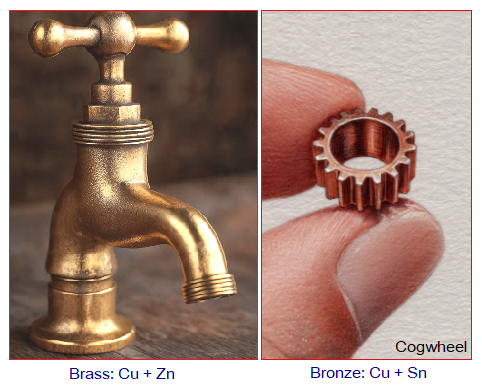
It is an alloy known since ancient times. Mostly, it is composed of 70 % copper and 30 % zinc. However, some other elements are also mixed in fractions.
The bronze is another similar alloy of ancient times; but with the composition of copper and tin (Sn) the main ingredients. The ratio of Cu is higher as compared to Sn.
In Urdu, the brass is recognized as ‘peetal’; while bronze as ‘kaansi’.
Fascinating Information:
The modern Olympic games were started in 1896 in Athens (a capital of Greece- a Southeast European country), but then there were no standard medals for the top positions of the winners. Later on, during Olympics of St. Louis (a city of USA), 1904, the standard medals were introduced as gold medal to first position, silver medal to second, and bronze medal to third position in ranking. However, the brass has never been used to make a standard medal to date.
Stainless Steel:
The development of non-rusting steel was started at the end of 18th century in Germany and England. The alloy stainless-steel has various different forms. One of them is Fe-Cr-Ni-C alloy; where iron is more than 70 %, chromium is more than 16 %, nickel is more than 8 %, while carbon is in fraction. In this category, the ratio of these elements varies by percentages in different of its types. For example: grades 304, 316, 410 etc. are various stainless-steel alloys.
Structure of an Alloy that Enhance the Properties of Metals:
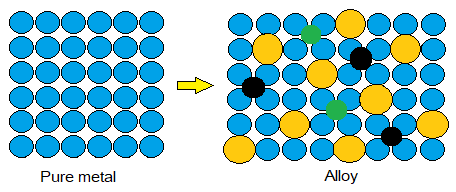
In pure metal, the layers of atoms are not composed of different elements. Thus, the single type of atoms makes the layers to slide easily due to having more flexibility. However, the layers of mixed atoms reduce the flexibility of the material due to hinderance. Consequently, the hardness is improved and layers don’t slide easily as were. This structural modification imposes its overall impact on the material and enhances the properties.
Uses of Alloys:
1.Stainless Steel Grade 304:
It is used in the:
- manufacturing of kitchen utensils, such as pans, pots, sinks,
- manufacturing of water pipes,
- manufacturing of household appliances.
2. Stainless Steel Grade 316:
It has more resistance against corrosion; so, used in the:
- manufacturing of marine equipments,
- manufacturing of surgical equipments,
- manufacturing of swimming pools fittings.
3.Stainless Steel Grade 410:
It is a harder steel, but having relatively less ability to resist against corrosion; so, used in the:
- manufacturing of cutlery utensils, like blades of knife, fork, teaspoons, water glass, plates for food etc.,
- manufacturing of engine parts,
- manufacturing of fasteners, like screw, nuts, bolts,
- manufacturing of pumps, and plumbing fittings, like valves,
- manufacturing of surgical instruments.
4. Brass:
It is used in the:
- manufacturing of door handles,
- manufacturing of musical instruments,
- manufacturing of plumbing fittings, like valves, taps etc.,
- manufacturing of fasteners, like screw, nuts, bolts.
5. Bronze:
It is used in the:
- construction of sculptures, statues,
- manufacturing of marine propellers,
- manufacturing of cogwheels, gears and other machine parts,
- manufacturing of bells,
- manufacturing of musical instruments,
- manufacturing of coins and medals.