Dr. Mudassar Altaf, Associate Professor of Chemistry, Department of Higher Education, Government of the Punjab, Pakistan
Contents:
- Metals: Definition
- Thermal conductivity
- Good conductors of electricity
- Metals are malleable
- Metals are ductile
- Melting & boiling points
- Reactivity of metals
- Metals with dilute acids
- Metals with cold water
- Metals with steam
- Metals with oxygen
Metals: Definition:
“The elements that are can lose easily electron(s) to make cations, conduct heat and electricity, malleable, ductile, sonorous, and having shiny surface are called metals”.
Thermal Conductivity:
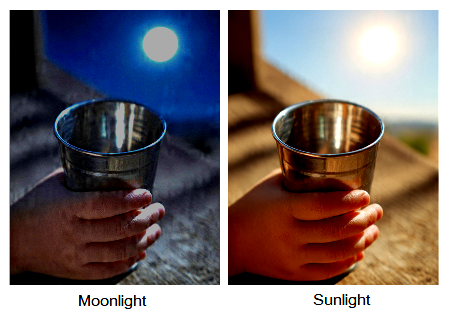
One of the main features of the metals is that they are good conductors of heat. Thermal is a synonym of heat. This conduction is due to the reason of having free electrons, called electronic cloud. Few topics related to metals have also been covered in the link metallic bond and properties of metals. These free electrons absorb heat and their kinetic energy increases to move them fast. So, the heat is transferred throughout the matter. Therefore, when we touch a metal object under sunlight, particularly in summer, it gives a burning feeling to our fingers. However, when we touch the same object in night, we feel it cool.
Good Conductors of Electricity:
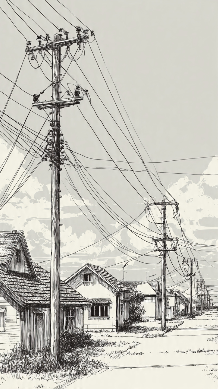
Like thermal conductivity, the metals are also good conductors of electricity due to the same reason of availability of free electrons that move to make flow of electric current.
Metals are Malleable:
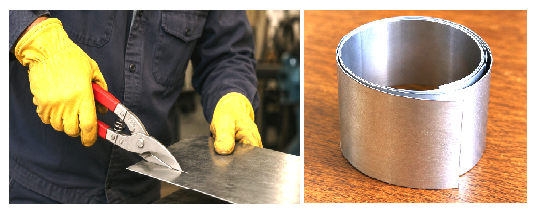
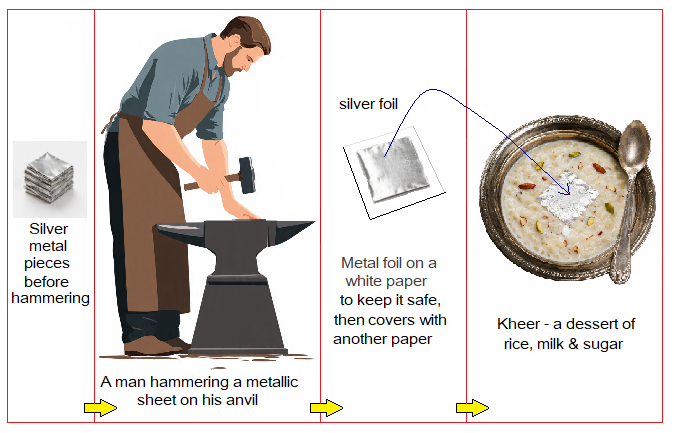
The malleable means that the metals can be hammered to make sheets. For etymology click on metallic bond and properties of metals. The sheets can be cut with scissor. Also, these can be rolled without any crack. The hammering can slide over the layers of atoms and change the gauge of the sheet to thin.
Fascinating Information:
- It is an old Asian tradition that a thin silver foil is used on the tops of Asian sweets, called ‘Verq’ meaning ‘a page, a foil’ as shown in the following diagram.
- Nobel Laureat, Earnest Rutherford (1871 – 1937) was a professor of physics at University of Manchester, UK, who performed his experiment on a very thin gold foil, roughly 0.00004 cm, and discovered atomic structure.
Metals are Ductile:
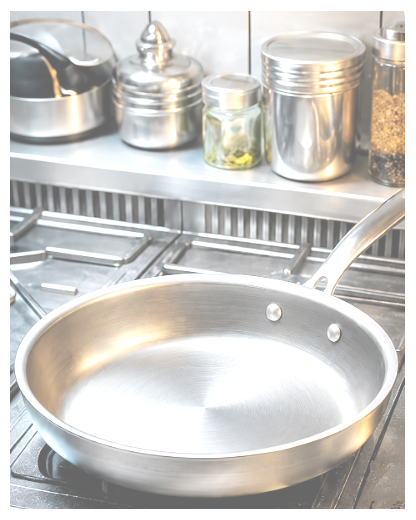
The term ‘ductile’ means ‘the material that can be changed into any shape without breaking / cracking’. Because, there is flexibility in metals, thus, can be molded into any shape; even long wires can be made, for example, electrical wires. Many of the kitchen accessories are made up of metals, for example, kitchen pans, containers, stove, & other kitchen utensils etc.
Melting & Boiling Points:
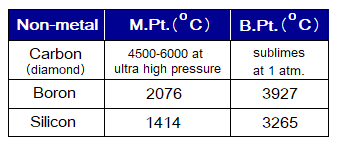
The metals have relatively higher melting and boiling points as compared to semi-metals and non-metals. Among non-metals, few have their higher melting and boiling points, like carbon, boron, silicon.
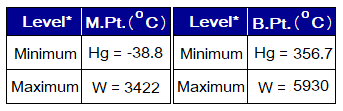
Few metals have low melting points. Mercury is the only metal exists in liquid state at room temperature. Cesium, rubidium and gallium are the metals exist in solid state in winter while liquid in summer season. Potassium and sodium relatively have lower melting points, but they exist in solid state even in hot summer season.
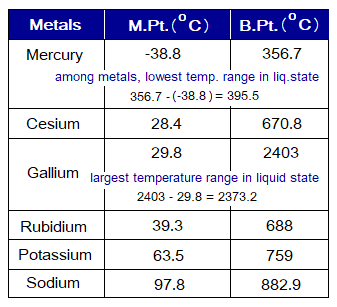
Among metals mercury (Hg) has its lowest melting and boiling point; and tungsten has its highest both the values.
Metals with Dilute Acids:
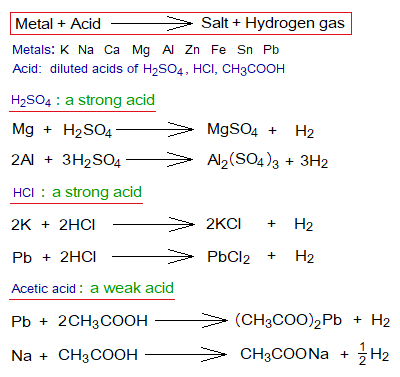
- The reactive metals, K, Na, Ca, Mg, Al, Zn, Fe, Sn, Pb, react with dilute acids, yielding salt and hydrogen gas.
- The less reactive metals, Cu, Hg, Ag, Pt and Au, do not react with dilute acids.
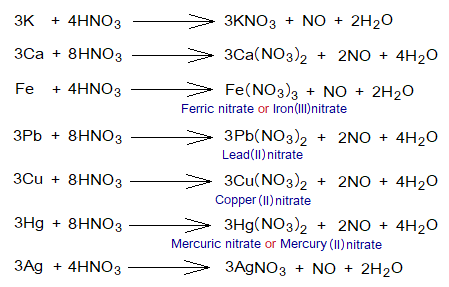
- Excluding Pt & Au, the metals react with dilute solution of nitric acid, yielding a metal nitrate salt, water and nitrogen oxide (NO or NO2) gas. Typically, very dilute acid forms NO, while higher concentration favours the formation of NO2.
- NO is called nitric oxide; nitrogen monoxide; or nitrogen(II) oxide.
- NO2 is called nitrogen dioxide; or nitrogen(IV) oxide.
Metals with Cold Water:
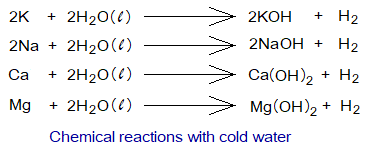
Few metals react with cold water, yielding the alkalis and hydrogen gas.
- K reacts violent, while Na reacts vigorously. Violet reactions are extremely vigorous and explosive. Vigorous reactions are fast and energetic and release a large amount of energy.
- Calcium reacts fast, while magnesium reacts slow.
- Aluminium forms a protective covering of aluminum oxide (Al2O3) and further reaction stops.
- Zinc, iron, tin, copper, mercury, silver, platinum and gold don’t show chemical reactivity with cold water.
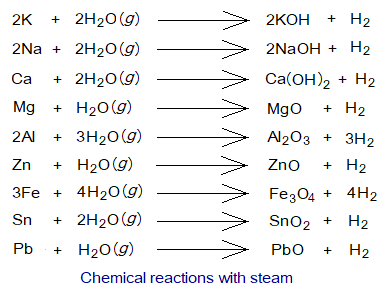
Metals with Steam:
Relatively more metals react with steam as compared to cold water, yielding alkalis or oxides, and hydrogen.
- K shows violet while Na shows vigorously reaction. Ca reacts fast. These three metals form alkalis.
- Mg shows fast reaction, yielding oxide.
- Al & Zn react with steam when metals are heated, yield metal oxides.
- A red-hot Fe reacts with steam and its oxide is formed.
- Sn (tin) and Pb show slow reactions; and their oxides are formed.
copper, mercury, silver, platinum and gold don’t have a chemical reactivity with steam.
Metals with Oxygen:
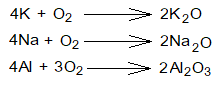
The metals have shiny appearance of their surfaces. However, this luster loses due to chemical reaction with oxygen and moisture present in air. The metallic oxide is formed over the surface of the metals. In most of the cases, this metallic oxide acts as a protective layer and stops more deterioration of the metal; as in case of Al, a layer of aluminium oxide (Al2O3) is formed on the surface. But iron oxide, the rust of iron, doesn’t provide protective covering; and gradually, metal wears away due to corrosion. Pt and Au don’t corrode with atmospheric oxygen and moisture.