Dr. Mudassar Altaf, Associate Professor of Chemistry, Department of Higher Education, Government of the Punjab, Pakistan
Contents:
- Reactivity series of metals: Definition & description
- Metals’ reactions with dilute acids
- Metals react when are cations
- Metals’ reactions with cold water
- Metals’ reactions with steam
- Metals’ reactions with oxygen
- Displacement reactions: Definition & examples
- Experimental verification of displacement reaction
Reactivity Series of Metals:
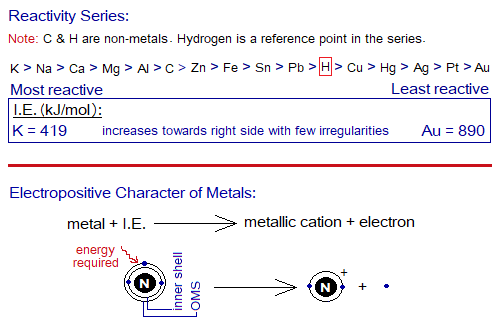
Definition: “A list of metals that are arranged in descending order of their chemical reactivities”. How the metals readily lose their electron(s) from outermost shell to form cations, defines their tendency of electropositive character. This is the ionization energy (I.E.) of the metals to make cations by removing OMS electron and for that the energy is needed, called I.E. More readily the electrons are removed, higher would be their chemical reactivity. Less is the I.E., more reactive will be the atom in its cationic formation.
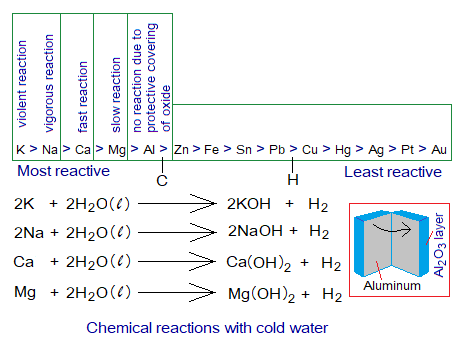
The chemical reactivity of the metals can be comprehended by using their reactivity series. For some selected metals, following is a figure given called reactivity series of metals which interprets to what extent a metal is reactive relevant to one another. In this order of reactivity on the continuum, the potassium is the most reactive one; and moving towards right the reactivity decreases, ultimately, at the end the least reactive metal is gold (Au). So, by keeping this series in mind, the metals have been discussed related to their reactions with dilute acids, cold water, steam, and atmospheric oxygen.
Metals with Dilute Acids:
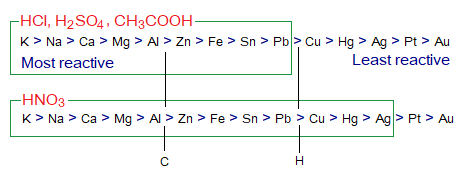
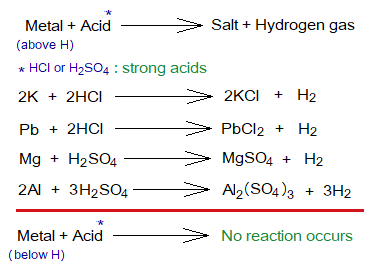
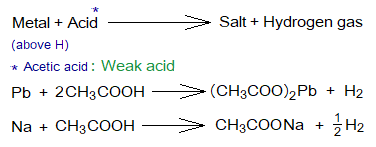
- By a general trend, the metals (towards left-side) above hydrogen in the series react with dilute acids like HCl, H2SO4, CH3COOH; yielding salts and hydrogen.
- The metals (towards right-side) below to the hydrogen are Cu, Hg, Ag, Pt and Au in the series. These metals do not react with above dilute acids.
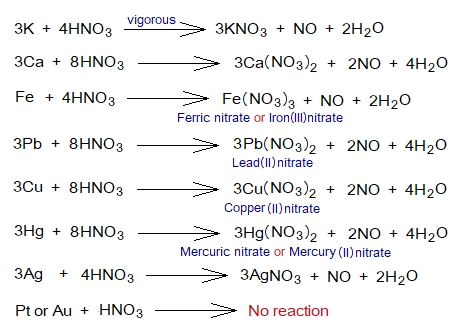
- The dilute aqueous solution of nitric acid reacts with metals from K to Ag; but don’t react with Pt and Au.
Metals React When are Cations:
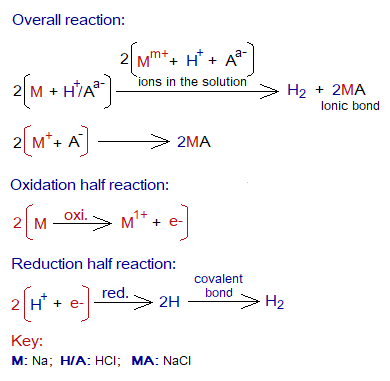
These are the Redox reactions; for in-detail study, open the link redox reactions. The metals don’t react unless make cations by oxidation (removal of OMS electrons). Because, these are electropositive. These electrons are used in the reduction of protons (H+) to make neutral hydrogen atoms; thereupon, they form hydrogen molecules by covalent sharing.
Dilute nitric acid yields salt, water, and nitrogen monoxide (NO) gas instead of H2 when reacts with metals. In certain cases, nitrogen dioxide (NO2) gas is also formed.
Metals with Cold Water:
Few metals react with cold water, yielding alkali and hydrogen.
K & Na show violent and vigorous reactions respectively. Violent is uncontrolled and dangerous; while, vigorous is very fast, energetic but not as dangerous as violent. In open air, these metals can catch fire with the moisture of air. So, these are stored in kerosene or paraffin oil (aka mineral oil). Don’t confuse kerosene oil with paraffin oil, both are different fractions of petroleum; discussed on the link https://chemiologist.com/arrangement-of-elements/
.
- Calcium shows fast reaction, but doesn’t having a violent or vigorous reaction.
- Magnesium shows slow reaction with cold water.
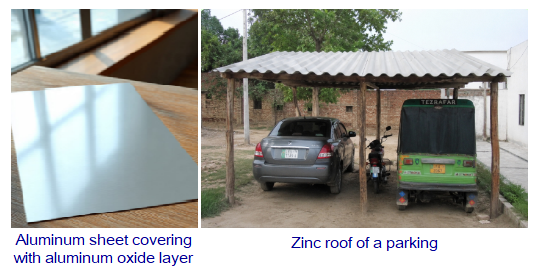
- Aluminium (also aluminum) forms a protective covering of aluminum oxide and further reaction stops.
- Zinc to gold, the metals don’t react with cold water.
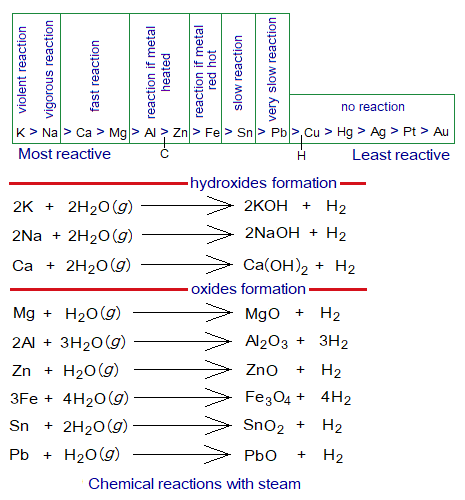
Metals with Steam:
Relatively more metals react with steam as compared to cold water.
- K violently, and Na vigorously react, yielding alkalis and hydrogen.
- Ca & Mg show fast reactions, yielding calcium hydroxide and magnesium oxide respectively together with hydrogen.
- Al & Zn heated metals react with steam, yielding metal oxides and hydrogen gas.
- Fe reacts when the metal is red hot, yielding iron oxide and hydrogen.
- Sn (tin) shows slow, while Pb (lead) shows extremely slow reaction; and in both cases, metal oxides and hydrogen gas are produced.
- Cu to Au, no metal reacts with steam.
Metals with Oxygen:
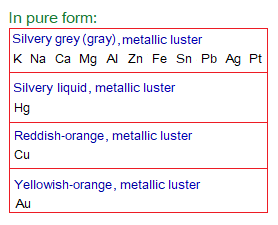
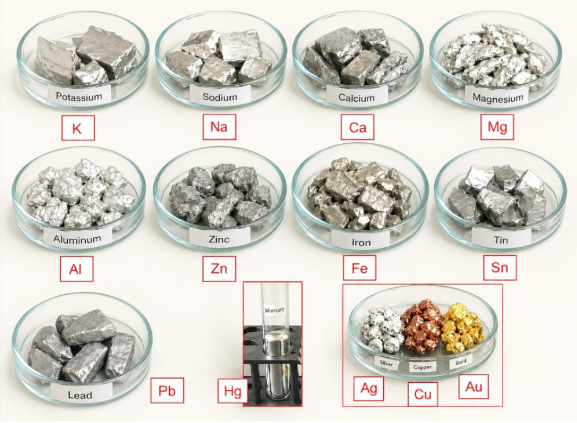
Mostly, the metals are silvery grey with few exceptions, like copper and gold. It is a characteristic property of metals that they have a metallic luster and in pure form their surfaces shine. Moreover, almost all the metals are solids at room temperature except mercury which is a liquid; but its liquid also shines with silvery grey metallic luster.
The metals react with the atmospheric oxygen and lose their shiny appearance. So, they become tarnish (dull). Most of the metals form an oxide layer over their surface. This layer becomes a protective covering against further decay of the metal. For, example, aluminium oxide (Al2O3) is a layer that is formed on the surface of aluminum metal. Aluminum oxide cover provides a protection against further oxidation of the metal. However, iron corrodes (rusting) by forming iron oxide. It is our common observation that the rust wears away the iron.
- Na and K show vigorous and violet reactions respectively with atmospheric oxygen.
- Ca and Mg reactions are slow.
- The tendency of chemical reactivity goes on decreasing towards right side of the reactivity series; ultimately, the platinum and gold don’t react with atmospheric oxygen.
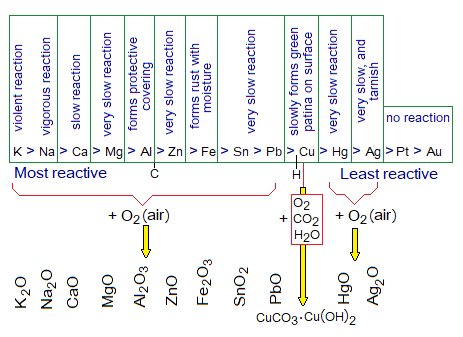
The above diagram shows that metals form oxides with atmospheric oxygen.
Exercise 1:
Write balanced chemical equations of metals with O2.
Fascinating Information:
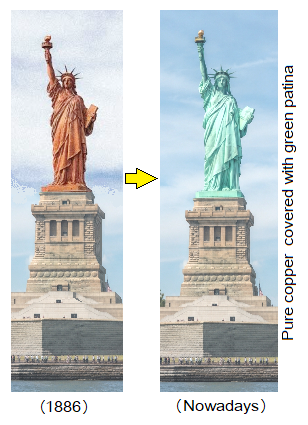
It is interesting to know that the Statue of Liberty of New York is a pure copper body. This monument was erected in 1886. However, gradually, with the passage of time its surface became green called ‘green patina’ as a protective covering. So, during maintenance this patina is not tried to remove to avoid further damage of the copper inside the layer. Patina has its Latin origin and having its meaning of change of the surface colour of the metal with the passage of time (age factor) due to atmosphere / weather.
Displacement Reactions:
Definition: “The chemical reactions in which a less reactive metallic ion is replaced from its compound by a more reactive metal”,is called displacement reaction.
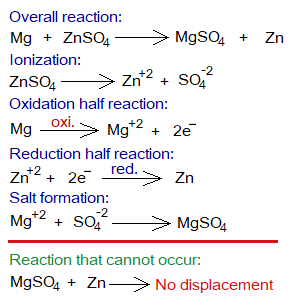
According to reactivity series of metals, the more reactive metal can displace another a less reactive metallic cation from its salt. For example, Mg is more reactive than Zn. Thus, Mg will displace Zn cation from its salt (ZnSO4) by means of redox mechanism. The oxidation takes place in a more reactive metal; while reduction takes place in a less reactive metal cation. Resultantly, Zn ions will reduce to neutral atoms; and MgSO4 salt will be formed. Because of more reactivity as compared to Zn, the magnesium likes to stay in its cationic form in the aqueous solution. The cations and anions balance each other in the solution. Thus, Zn2+ cations do not stay in the solution and reduce to neutral atoms; subsequently, will be deposited out of the solution.
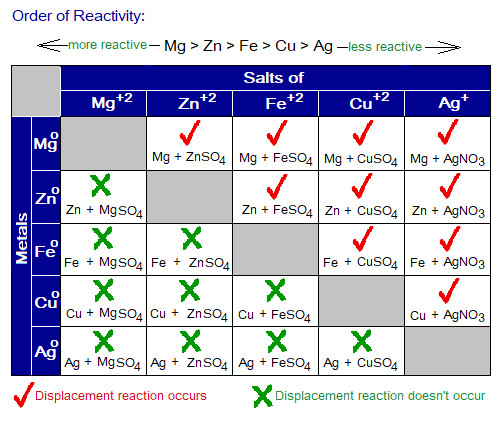
Among the following few selected metals, magnesium is the most, while silver is the least reactive on the continuum of reactivity series, as shown below. Further, the following table shows the displacement reactions that can and can’t occur among these metals and compounds. Try to grasp the concept.
Exercise 2:
- The reactants given in above boxes of the table. Write overall balanced chemical equations for the reactions where displacement occurs. Note: No need to write redox mechanism.
- Justify the reasons where the displacement reactions don’t occur.
Experimental Verification of Displacement Reaction:
Step 1:
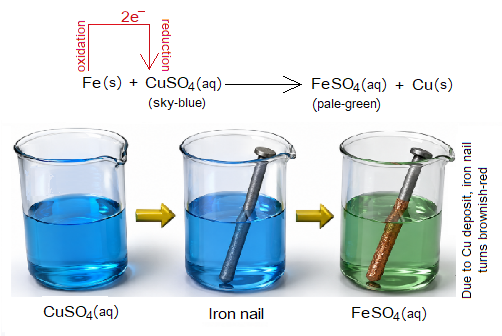
- Take 0.1 – 0.2 molar copper sulfate aqueous solution in a 100 cm3 beaker. It is sky-blue in colour.
- Get an iron nail having no rusting on its surface; otherwise, remove by sandpaper. The nail without rust will be grey.
- Drop the nail into the solution of copper sulfate; and leave it for half an hour.
Observations:
- The sky-blue shade of the solution will fade gradually to become pale green.
- The iron nail will get a coating of reddish-brown due to depositing of copper on it.
Conclusion:
- Because, the iron is more reactive metal as compared to copper. Thus, it will displace the copper cations from the solution by means of Cu-reduction. And iron will oxidize to make Fe+2 ions in the solution; balancing with SO42- ions.
Step 2:
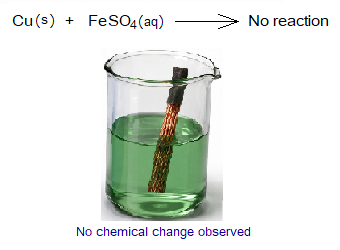
- Now, prepare a fresh ferrous sulfate 0.1 to 0.2 molar and pour into 100 cm3 beaker.
- Take an electric cable of pure copper; and remove its rubber covering.
- Dip the copper, as shown in the figure below, into the solution; and leave even for a longer period of time to wait for the change.
Observations:
- No change in the solution colour (pale-green) will be observed.
- No change in the colour of copper material (brownish-red) will be observed.
Conclusion:
- Because, the copper is less reactive metal as compared to iron. Thus, it will not be displaced by the iron cations of the solution. So, no chemical reaction will be occurred.