Dr. Mudassar Altaf, Associate Professor of Chemistry, Department of Higher Education, Government of the Punjab, Pakistan
Contents:
- Postulates of Kinetic Particle Theory of gases
- A relationship between temperature & volume of a gas
- A relationship between external pressure & volume of a gas
- Experimental demonstration to observe P & V relationship
Kinetic Particle Theory of Gases: Postulates
This theory has the following postulates related to gases.
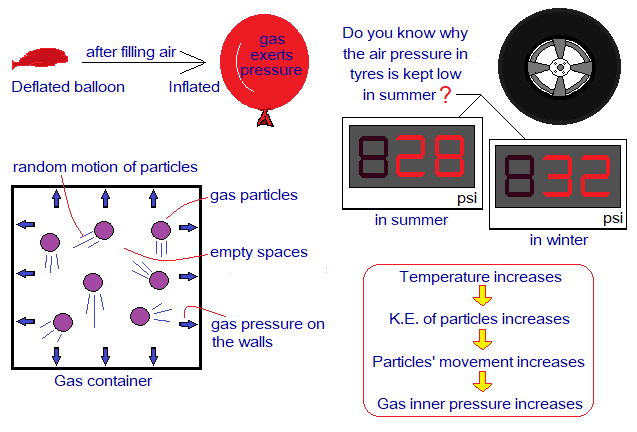
- Gases are made up of tiny particles (atoms or molecules) which are far apart from each other, and have a lot of space between.
- These particles move with constant and random motion.
- The particles create an inside pressure of the gas which is imposed on the walls of the container.
- By increasing the temperature, the gas pressure increases. The kinetic energy of particles is increased by rising up the temperature; resultantly, their motion increases.
- The volume of the gas is increased by increase in temperature; and vice versa.
- The volume of the gas is decreased by increase in external pressure; and vice versa.
Temperature & Volume Relationship of Gas:
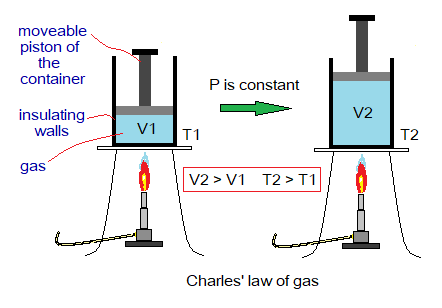
By a simple definition, “the volume of a gas has a direct relationship with temperature at a constant pressure”. Mathematically, it would be expressed as:
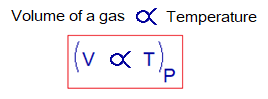
The ‘α – alpha’ is a Greek alphabet that is used as a symbol to show relationship between two variables (V & T).
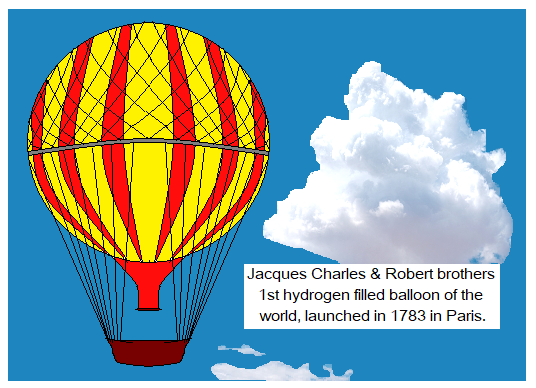
This relationship was formulated by Jacques Alexandre Cesar Charles (1746-1823) in 1787. So, this law is known as Charles law of gases. He was a French professor of science and flew a world first balloon in 1783 by working with two brothers, who were engineers, Anne-Jean Robert and Les Freres Robert, and they built the balloon.
Suppose, V1 is initial volume of a gas at temperature T1. When temperature of the gas is increased by T2, the volume of the gas is also increased by V2 at constant external pressure. In other words, the gases expand by rising the temperature; also known as thermal expansion.
Relationship Between External Pressure & Volume of Gas:
By a simple definition, “the volume of a gas has an indirect relationship with applied (external) pressure at constant temperature”. Mathematically, it would be expressed as:
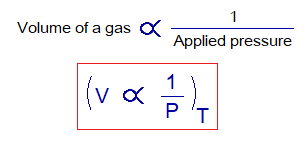
This relationship was formulated by an Irish scientist and philosopher Robert Boyle (1627-1691) in 1662. So, this law is known as Boyle’s law of gases.
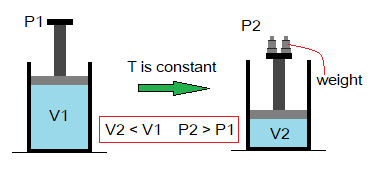
Suppose, V1 is initial volume of a gas at pressure P1. When external pressure on the gas is increased by P2, the volume of the gas is decreased by V2 at constant temperature. In the diagram below, it is shown that the weights are used on the moveable piston to apply pressure on the gas. Hence, the volume of the gases has inverse relationship with applied pressure.
Experiment:
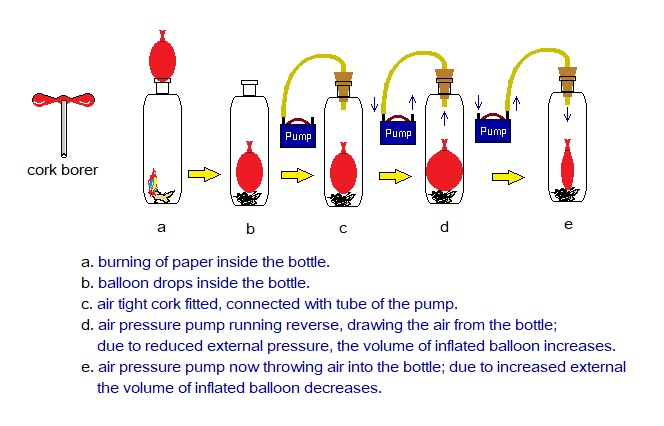
A simple experiment explains the effect of external air pressure on the volume of air inside a balloon.
Materials: Glass bottle with a cork, a balloon, a match box, paper, air pump with tube, cork-borer set.
Experimental Procedure: Follow these steps as given below:
- Inflate a balloon just a little, but not overfill. And tie a knot at the end.
- Take a piece of paper and light it using matchstick. Then, drop this burning paper immediately into the bottle.
- Put the inflated balloon onto the mouth of this bottle containing burning paper.
- The inner air (oxygen) in the bottle will be used for burning of paper and will reduce inside air pressure; and resultantly, the balloon will drop into the bottle. Due to consumption of oxygen the fire will be extinguished; consequently, combustion will be stopped. The balloon during its stay on the mouth of the bottle will not allow outer air to go inside the bottle.
- Now, using a specified cork-borer, make a hole into the cork just to pass an air pressure tube; and fit onto the bottle mouth. Be careful, there must not be a gap between the tube and cork; so that no air is allowed to pass through. If there is a gap, seal it with silicone gel and wait until it dries. Candle wax can also be used.
- Notice the size of the balloon.
- Fit the outer end of the tube on the vacuum nozzle of the pump; and allow air to pump out of the bottle. It will be noticed that the balloon size (air volume inside balloon) increases as the air pressure (external pressure within the bottle but outside the balloon) decreases.
- Now shift the tube on air pressure nozzle of the pump; and allow the air to flow inside the bottle. It will be observed that the balloon size decreases as the air pressure increases.