Dr. Mudassar Altaf, Associate Professor of Chemistry, Department of Higher Education, Government of the Punjab, Pakistan
Contents:
- Composition of air
- Air pollution: definition
- Air pollutants: definition
- Carbon dioxide as air pollutant
- Carbon monoxide as air pollutant
- Methane gas from soil as air pollutant
- Methane gas from animals as air pollutant
- Oxides of nitrogen as air pollutant
- Sulphur dioxide as air pollutant
- Adverse effects of air pollutants
- Global warming by CO2 higher level
- Greenhouse gases & their effect
- Carbon-monoxide a toxic gas
- Particulates: an increased risk of respiratory problems & cancer
- Methane & global warming
- NOx, acid rain, photochemical smog & respiratory problems
- Sulphur dioxide & acid rain
- Global warming by CO2 higher level
- Strategies to reduce the effects of environmental issues
- Use of catalytic converters in automobiles
- Using low sulphur fuels
- Flue gas desulfurisation (FGD) using CaO
- Photosynthesis: definition & explanation
Composition of Air:
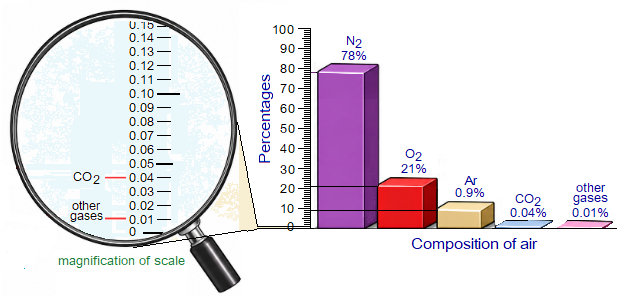
Non-polluted air is a mixture of different gases with constant proportions, as mentioned below:
- Nitrogen (N2): 78%
- Oxygen (O2): 21%
- Argon (Ar): 0.9%
- Carbon dioxide (CO2): 0.04%
- Other gases: 0.01%
The other gases are, helium, neon, krypton, hydrogen, methane etc. Humidity is also a part of unpolluted air. Its percentage is not constant but varies according to geographical location, temperature, rainfall, evaporation, climate and weather.
Air Pollution: Definition
“The presence of unwanted and harmful substances in air”.
Air Pollutants: Definition
“The unwanted and harmful gases, smoke, dust, soot (carbon particles), and other toxic substances” are called pollutants. Few common pollutants like, oxides of carbon, oxides of nitrogen, methane and sulphur dioxide have been discussed below:
1. Carbon Dioxide as Air Pollutant: It is aforementioned that the normal CO2 concentration is 0.04%, but when it is above to its normal value, it is harmful. The following are its main sources of its production and the means of making it pollutant:
- Burning of wood
- Burning of biomass
- Burning of natural gas
- Burning of coal in domestic use, hotels, power plants
- Industrial waste in the form of exhaust gases
- Fuel burning in automobile engines
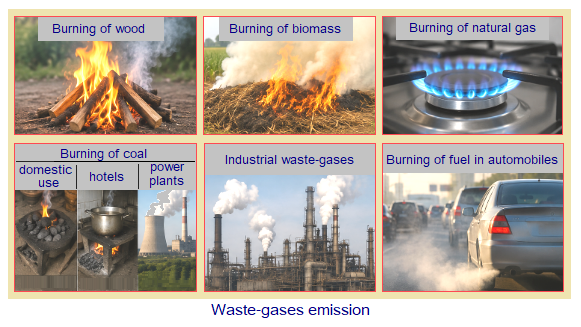
These are the organic matter in the above figure due to carbon containing compounds; hence, produce CO2 and water by complete combustion (burning) in the presence of oxygen gas of air. The energy is also released in the form of heat.

2. Carbon Monoxide as Air Pollutant: When there is a limited amount of oxygen available, then, carbon monoxide gas is also produced along with CO2 as a result of incomplete combustion. Also, the solid particulates of carbon are formed, called soot. The energy released is less than complete combustion.

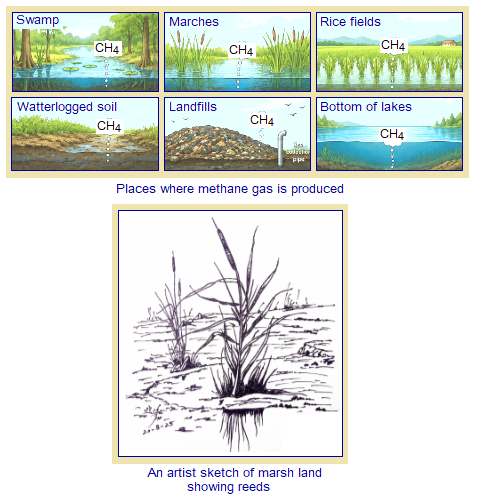
3. Methane Gas from Soil as Air Pollutant: The plant dead materials fall on the ground and the anaerobic microorganisms called methanogenic archaea decompose them in the absence of oxygen yielding methane and carbon dioxide gases along with other products.
Secondly, there are oxygen-poor places, like marshes, swamps, landfills, waterlogged soil, bottom of lakes, rice fields, where methanogenic archaea anaerobically decompose the plant materials to produce methane gas.

Swamp is a spongy wetland, where trees and shrubs grow. Marsh is also a wetland dominated with grass and reeds. Waterlogged soil is the soil which is completely soaked with water; or in other words, so saturated (logged) with water that air spaces in the soil are filled with water. Landfills are the places where waste (debris, garbage etc.) is buried.
Fascinating Information:
Archaea are single-celled microorganisms; and the etymology is Greek from the word ‘archaios’ meaning ‘ancient’. They are believed the ancient microorganisms, i.e., the oldest form exists on the Earth. They are similar to bacteria but not in true sense due to structural dissimilarities, although many features are common. Archaea can exist in extreme environment like acidic, salty, deep ocean, oxygen-free, and very hot places. The methanogenic archaea live in waterlogged soil where the oxygen is limited or absent.
4. Methane Gas from Animals as Air Pollutant: The ruminants (sheep, goat, deer, buffaloes, cows, camels) discharge methane gas from their bodies through flatulence and belching. The waste gases pass through anus is called flatulence; and through mouth is called belching or burping. Among the mixture of various waste gases, methane is one of them. How methane is produced in their bodies, described below briefly:
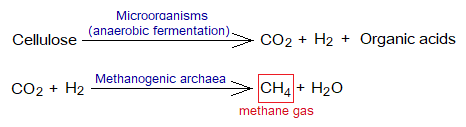
- Gut microbiomes are microorganisms like, bacterium, protozoa and fungi live in alimentary canal of these animals at various locations. They break down cellulose anaerobically. This cellulose comes from their food they eat. Obviously, they eat grass, leaves and other plant materials. This is anaerobic fermentation and produce CO2, H2 and organic acids.
- Then, methanogenic archaea convert CO2 & H2 into CH4 and H2O. These archaea also live in gut (digestive tract / alimentary canal) at various locations.
5. Oxides of Nitrogen as Air Pollutant: There are two oxides of nitrogen which are air pollutants. These are NO and NO₂ and collectively called NOx.
- Nitric oxide (NO): a colourless gas,
- Nitrogen dioxide (NO₂): a reddish-brown gas.
The internal combustion engine of automobiles uses oxygen from air to burn fuel at very high temperature. There is 78% N2 and 21% O2 in air. These two gases react together at about 1000°C and produce NO gas which thereafter reacts with O2 and produce NO2 gas. The NO2 and unconverted NO form a mixture of NOx which is released in air.
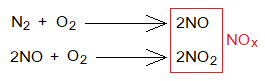
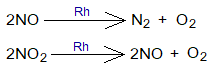
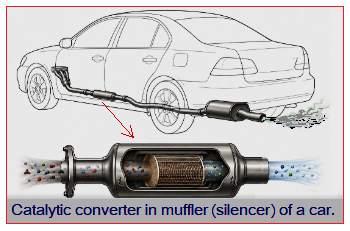
Nowadays, in modern vehicles, a catalytic converter in fitted in their exhaust pipes (silencer, muffler) which converts NOx gas mixture into N2 gas prior to exhaust. Mainly rhodium (Rh, atomic number 45, transition metal) is used as a catalyst. It has been discussed later.
6. Sulphur dioxide as Air Pollutant: Natural gas, coal, petroleum are called fossil fuels. They contain sulfur in their composition which burns in the presence of O2 to form sulfur dioxide (SO2) by oxidation. Coal is burnt in power plants, cooking and in brick making kiln. Industrial furnaces also discharge this pollutant in air by burning fossil fuel. Automobiles, railway engines and ships also use fossil fuel. During smelting process SO2 is also discharged into air. Smelting means extraction of metals from their ores by heating them at high temperature using coke as reducing agent.

Adverse Effects of Air Pollutants:
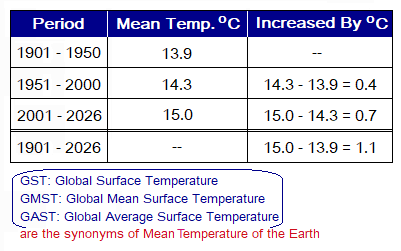
1. Global Warming by CO2 Higher Level: The global warming is defined as, “the increase in average temperature of the earth at its surface including land and ocean”. The average temperature of the globe is 14 to 15°C. The average rise is 1.1°C during a span of more than 125 years; the period mentioned in the following table.
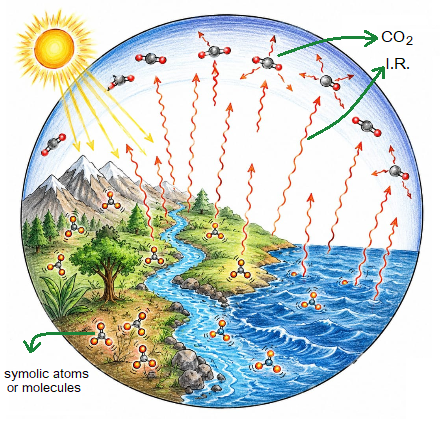
Another term is greenhouse gases and defined as, ‘the gases of the earth’s atmosphere that can absorb and trap infrared radiation (heat) emitted from the earth’s surface, and cause the atmosphere warm enough that is suitable for life”.
The heat comes from the sun in the form of visible light. These waves heat the water bodies, ocean, rivers, ponds, etc. land and plants by absorption. Their atoms/ molecules vibrate at absorbed heat and emit infrared radiations (I.R.). As an average the earth surface emits 390 joules or watts I.R. per second on an area of meter square (1watt=1joule). Some I.R. escapes into space; some is trapped by ozone layer and greenhouse gases. CO2, H2O vapours, NOx, and CH4 are the greenhouse gases.
The earth planet has its normal values related to temperature, humidity, gases etc. that is favorable for growing plants. So, warming on the earth is an essential feature for their normal growth; and these gases play their significant role in this concern. Thus, the name is given greenhouse gases. This is called greenhouse effect and is defined as, “the process by which greenhouse gases of the earth’s atmosphere trap outgoing infrared radiations (heat) and cause the earth’s surface warmer” is called greenhouse effect.
Fascinating Information:
Stefan–Boltzmann law is a mathematical relationship that measures the energy emitting from the earth’s surface in watts per meter square (W/m2).
Before industrial revolution around 1750 A.D., CO2 was 0.03%, but now it is 0.04%. Although, it is a little change, but it has strengthened the greenhouse effect by absorbing more I.R. and has reduced the amount escaping into the space; resultantly, overall, a little rise in average temperature is a mean of climate change. Few examples have been given below:
- Rise in average temperature of the earth.
- Before time melting of glaciers and ice; causes flood that damages the fields, villages and cities. Due to heavy water in rivers, the level of sea goes high.
- More heat is absorbed by the ocean.
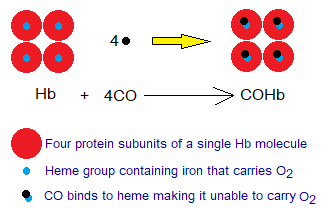
2. Carbon-monoxide a Toxic Gas: Unlike CO₂, the carbon monoxide (CO) might be a trace pollutant. Its percentage in heavy traffic area is as little as 0.0005–0.002%. It is highly dangerous gas; so, could not be a component of clean air. It is colourless, odourless, tasteless, and even doesn’t irritate eyes, nose, throat and lungs; so, a toxic gas goes to breathe in without realization. The oxygen carrying protein in red blood cells (RBC) is hemoglobin (also haemoglobin Hb). CO binds to this protein and forms carboxyhemoglobin (also called carbonyhemoglobin COHb or HbCO). For this reason, Hb cannot carry O2. Consequently, the body cells can’t get required O2, called hypoxia or oxygen starvation. Hypoxia has its Greek root from the word ‘hypo’ means ‘less than normal’; ‘oxi’ means ‘oxygen’; ‘ia’ for ‘condition’. So, it is a condition of less than normal oxygen. The poisoning caused by CO is called carboxyhemoglobinemia. Human beings and animals having Hb in their RBCs face the same issue of CO poisoning; eventually, causes death.
3. Particulates: An Increased Risk of Respiratory Problems & Cancer: The particulate matter (PM) is consisted of tiny solid particles or liquid droplets which are suspended in air as pollutant. Their sources are burning of wood, coal and biomass; the exhaust from automobiles, industrial waste-gases emission, dust from the construction, wildfire and smoke. Their classification depends upon their size:
- PM10: Their diameter is 2.6 – 10 micrometers; and are called coarse (rough in shape) particles. They penetrate into the upper respiratory tract.
- PM2.5: Their diameter is 0.2 – 2.5 micrometers; and are called fine particles. They penetrate into the lungs and even to bloodstream.
- PM0.1: Their diameter is 0.1 or less than to that in micrometers; and are called ultrafine particles. Through bloodstream they penetrate into various tissues.
They have high risk related to healthy respiratory tract, such as:
- Disturb normal lungs’ function: It triggers a ‘chronic obstructive pulmonary disease’ (COPD) causes trouble in normal breathing, coughing a lot, and formation of thick and dark mucus. Chronic has the meaning ‘severe or long-lasting’; and obstructive gives the meaning of ‘blocking’, i.e., a severe blocking of lungs airways; thus, it describes ‘making it difficult to breathe’. This condition also called ‘flare-up’ or ‘exacerbation’ (to make bitter or harsh). The patient suddenly burst out after a calm period; so, it is a psychological distress.
- The eczema might be appeared by red circles on the skin; also becomes dry, and itchy.
- The toxic particulates have a risk of cancer. For example, polycyclic aromatic hydrocarbons (PAHs); heavy metals, like arsenic (33As with atomic number), cadmium (48Cd), lead (82Pb); soot (carbon black).
Knowledge in Advance:
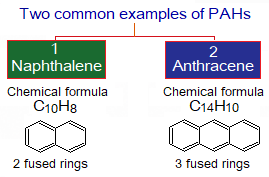
- PAHs are the organic compounds having fused aromatic rings in their structure. These are formed by incomplete combustion of the organic matter such as coal, wood, oil, gas, tobacco or garbage. Following are the two common examples given; naphthalene (two fused aromatic rings), & anthracene (three fused aromatic rings). These are volatile organic compounds (VOCs).
- Para-dichlorobenzene (PDCB) is a commonly used deodouriser block/cake for toilets. It is VOC and slowly sublimes (evaporates) into air; contains volatile fragrance compounds, such as limonene (having citrus fragrance) etc. But it poses health risks by causing irritation to eyes, respiratory tract, headache, nausea, bad effect on nervous system, and even organs’ damage by long-term exposure.

4. Methane & Global Warming: Around 1750, the pre-industrial period, the methane percentage (0.00007%) has increased by 180-190% approximately as of now; estimated from its original amount to the current percentage range 0.00019-0.0002. The molecules of methane gas absorb infrared radiations (heat) emitting by the surface of the earth. Thus, like CO2 molecules they have the same role in global warming and climate change. Both gases also play their role in reducing thermal energy loss towards space; otherwise, the required temperature of the globe couldn’t be maintained for the survival of life.
5. NOx, Acid Rain, Photochemical Smog & Respiratory Problems: As described in the preceding section that there are two types of nitrogen oxides, NO & NO2. Their source of emission has also been mentioned related to combustion of fuel in automobile engines. However, thermal power plants, industrial combustion, domestic fuel combustion like wood, coal, biomass, agricultural burning, waste incineration and volcanic eruptions are also the sources of emission.
a) Acid Rain: NO is oxidized to NO2. The nitrogen dioxide reacts with atmospheric water and produces nitrous as well as nitric acid. Nitrous acid (HNO2) is not a stable one in atmosphere and is oxidized to nitric acid (HNO3). However, a small amount of unconverted HNO2 is also present in acid rain. The HNO3 is dissolved in atmospheric water and reaches to the earth surface by precipitation (rain).
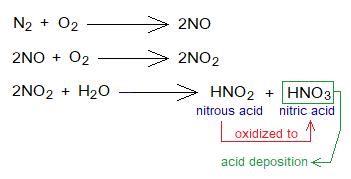
The acid is deposited on earth by two ways:
- Wet deposition: Nitric acid is deposited by rain, snowfall, hails, fog and mist.
- Dry deposition: The nitric acid also deposits as gas particles and settles directly on land, buildings, crops, plants, and water bodies.
The acid rain causes acidification of water bodies; so, dangerous for aquatic life, animals and plants. It also damages the crops and soil. It mobilizes metals from their minerals of the soil; and the metals further damage plants’ roots. Acid rain also corrodes the metals of the buildings.
b) Photochemical Smog: The ‘smog’ is a blend word (portmanteau) of ‘smoke+fog’. Photo means ‘light’; because, the chemical reactions are triggered under sunlight, hence, called ‘photochemical reactions’. By definition, the photochemical smog is “the air pollution that is formed when sunlight activates chemical reactions between volatile organic compounds (VOCs) and nitrogen oxides (NOₓ) in the atmosphere, producing secondary pollutants such as peroxyacetyl nitrates (PANs), aldehydes, and ground-level ozone (O₃)”. It is also called “Los Angeles-type smog” because it was first recognized in that city, located at southwestern region of USA on Southern California state at Pacific coast.
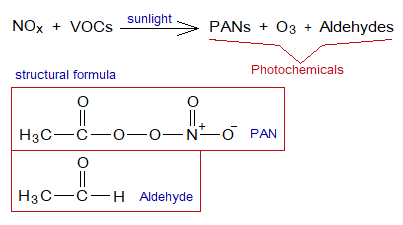
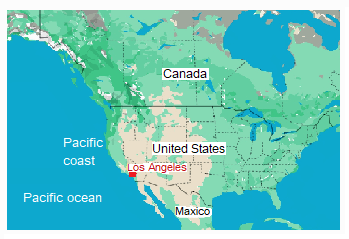
c) Respiratory Issues Related with Photochemical Smog: Photochemicals including ground-level ozone are harmful for respiratory tract. They cause the following health issues:
- Chronic obstructive pulmonary disease (COPD) as discussed above.
- An irritation in nose and throat.
- Due to inflammation and burning of respiratory tract, the coughing starts.
- Dyspnea: discomfort in breathing (shortness in breath). Also called chest tightness when it is severe then called asthma.
- Wheezing: due to narrowing airways, a whistle sound is produced during breathing.
- Bronchitis: There might be inflammation in bronchiole tubes of the lungs, causing mucus formation and coughing.
6. Sulphur dioxide & Acid Rain: The source of SO2 has been discussed in above section. Here, the discussion will be related to acid rain. (1) This gas is dissolved in water droplets and reacts chemically to produce first of all sulfurous acid (H2SO3), which is further oxidized to sulfuric acid (H3SO4). (2) Further, the SO2 also oxidises (oxidizes) to sulfur trioxide (SO3), which reacts with water to form H2SO4.
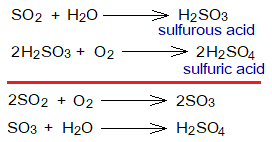
Like nitric acid, this acid also falls on earth surface by means of:
- Wet deposition: Sulphuric acid is deposited by rain, snowfall, hails, fog or mist.
- Dry deposition: The sulphuric acid also deposits as gas particles and settles directly on land, buildings, crops, plants, and water bodies.
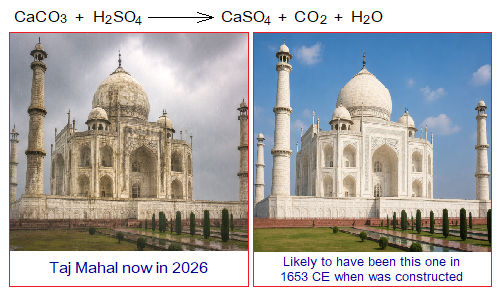
The rain containing sulfuric acid is as harmful as nitric acid rain. The acid also reacts chemically with marble/ limestone buildings (CaCO3) and causes their deterioration and discoloration gradually; like Taj Mahal, located in Agra city of Uttar Pradesh state of India.
Strategies to Reduce the Effects of Environmental Issues:
- Reduction of Waste-Gases Emission: The waste-gases emission, particularly CO2, should be controlled by reducing the use of fossil fuels emitting these gases. By encouraging the save energy sources, like batteries in electric vehicles, can reduce the use of fossil fuels. Thus, the emission of waste-gases can be controlled. The renewable energy sources such as solar system, or wind turbines to generate electricity are environment friendly and should be encouraged. Thus, the use of fossil fuels can be replaced with these renewable energy production technologies to reduce air pollution.
- Reforestation and Afforestation: There is need to grow more trees in already existing forests, called reforestation. Also, where there is no forest exists, new forests should be grown, called afforestation. During photosynthesis, the plants use CO2 from air and release oxygen. So, they maintain a balanced ecosystem by participating in natural cycles. By this way, the oxygen and carbon dioxide concentration remains normal in air. The carbon is also utilized in biomass synthesis in plants and all the living creatures; because carbon is an essential element in organic matter, like proteins, carbohydrates, lipids etc.
- Reduction in Livestock Over Farming: “Thedomestic animals are raised for milk, meat, agricultural and transportational purposes” is called livestock. For these purposes, buffaloes, cows, cattle, sheep, goats are raised. They emit CO2 and CH4 gases that contribute in greenhouse effect to cause global warming. The ruminants are essential animals for meat, milk production, and transportation; but their production should be controlled as per estimation of the need and over farming should be avoided.
- Encouraging the Use of Hydrogen Energy: Hydrogen gas can be used as a fuel; and is environment friendly, because it produces water and heat instead of carbon dioxide after electrolysis with atmospheric oxygen. The hydrogen cell has been discussed at the link https://chemiologist.com/hydrogen-oxygen-fuel-cells/ .
- Use of Catalytic Converters in Automobiles: “A device that is fitted into the exhaust pipe of the automobiles that converts harmful waste-gases into harmless gases by using catalysts, such as platinum, palladium or rhodium”, is called catalytic converter. The harmful gases, CO, NO, unburnt hydrocarbons (CxHy) are the harmful emissions and cause photochemical smog formation. However, CO2, O2, H2O, and N2 are harmless.
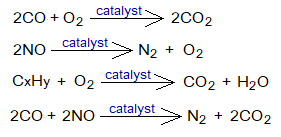
- Using Low Sulphur Fuels: The fuels should be purified by lowering the sulfur percentage. The low sulfur fuels will not produce excessive SO₂; so, the formation of H2SO4 will also be reduced in the atmosphere.
- FGD Using CaO: The waste-gases are also known as flue gases and they contain sulfur dioxide in their mixture. The SO2 is removed by a chemical treatment with calcium oxide (also called burnt lime or quicklime). The flue gases are passed through a reaction chamber containing quicklime prior to discharge into air through chimneys. The CaO chemically reacts with SO2 to produce calcium sulfite (CaSO3). This process is called ‘flue gas desulfurisation’ (FGD), and is carried out in industries and power plants. FGD is a useful technique to reduce the emission of SO2 in air. CaSO3 is an ionic solid, white or off-white crystalline powder.

Photosynthesis:
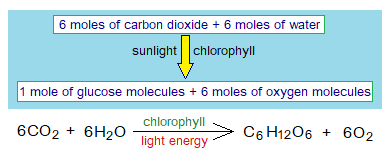
Definition: “A photochemical process by which the green plants, algae, and some bacteria make glucose (C6H12O6) and oxygen from carbon dioxide and water under sunlight” is called photosynthesis. Top of Form
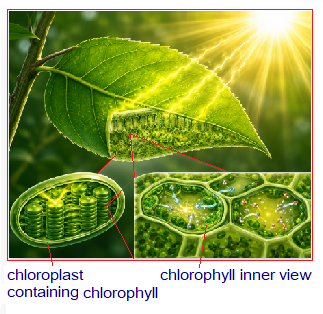
Chloroplast & Chlorophyll: Chloroplasts are cell organelles present in green parts of the plants particularly leaves, that contain green pigments called chlorophyll. The main role of chlorophyll is to absorb sunlight. Photosynthesis takes place in chloroplasts.
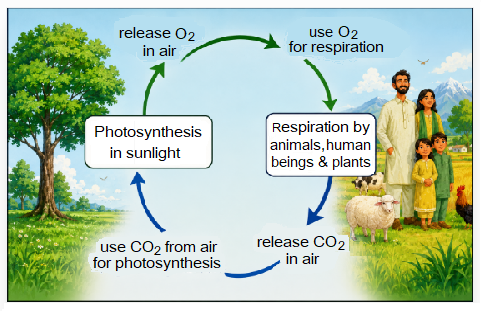
- Photosynthesis is not only the source of food synthesis in the form of glucose; but also provides oxygen to the atmosphere.
- The atmospheric CO2 is utilized as it is exhaled by animals during respiration. So, a natural cycle runs to keep both these gases percentage constant in the air.
A simple cycle related to photosynthesis, respiration, CO2 & O2 is given below.