Dr. Mudassar Altaf, Associate Professor of Chemistry, Department of Higher Education, Government of the Punjab, Pakistan
Contents:
- Ore versus mineral
- Extraction of metals & reactivity series
- Hematite ore
- Extraction of iron:
- Bauxite ore
- Treatment of bauxite ore
- Extraction of aluminum: Hall-Heroult process
- Importance of cryolite
- Why there is a need to replace anodes regularly?
Ore Versus Mineral:
The ore is a rock that contains minerals and is a natural source of metals; while a mineral is a natural substance of the earth that contains metallic cations and non-metallic anions. An ore might contain many minerals, such as halite is an ore that contains not only NaCl but also other impurities, like calcite (CaCO3), gypsum (CaSO4.2H2O), sylvite (KCl), sand, clay etc.
Extraction of Metals & Reactivity Series:
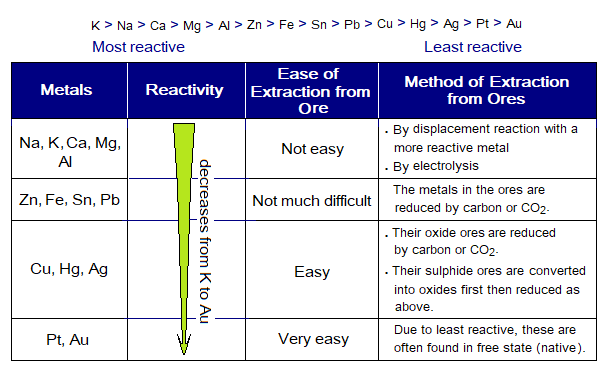
The extraction of metals from ores is easy or difficult depending upon the position on the reactivity series. The more reactive metals are difficult to extract as compared to less reactive metals. Because, the electropositive character of more reactive metals is stronger and thus they like more to make compounds. Following is a table given that describes the ease of extraction of a particular metal from its ore depending upon the relative position on the reactivity series. Moreover, which method is more appropriate for extraction for a particular metal has also been elaborated in the table.
Hematite Ore:
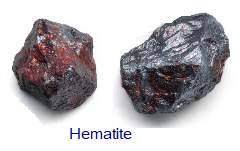
It is a natural ferric oxide (Fe2O3) exists in rocks and even in soil. The colour of the rock is gray to black, and reddish-brown streak. By mass, there is about 70 % iron present in the rock. Brazil, Australia, India, Pakistan, China, South Africa, Russia are the regions where hematite rocks exist.
Extraction of Iron:
The extraction of iron from hematite ore is carried out in blast furnace. The height of the furnace is 82-115 feet even more. It has different temperature zones, from 2200°C at the lower region to 200°C at the top. The furnace is made by an outer shell of steel plates, inner lining of fire-resistant bricks. Its working related to chemical reactions is given below:
- Raw material: Following raw material is used:
- Hematite ore, in the form of small pieces of stones, the lime stone (CaCO3) and the pure form of carbon (coke) is a mixture-feed to the blast furnace from its top. The raw material is supplied continuously for a continuous operation.
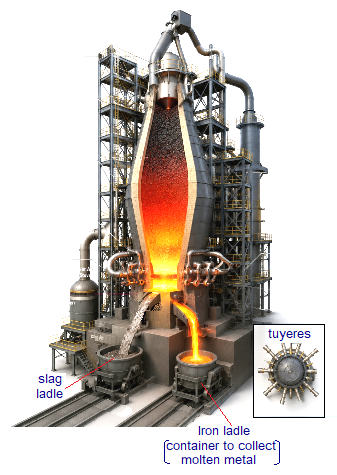
- Hot blast: At the temperature range of 900-1200°C, the hot air is blown into the furnace from its bottom through tuyeres. The ‘tuyere’ is an old French word ‘tuyere’ meaning ‘nozzle’. There are 12 to 40 such tuyeres depending upon the size of the furnace; and are located above to the hearth.
- Formation of CO: This hot air reacts vigorously with preheated carbon to produce CO2 gas at bosh region of the furnace. The CO2, then, reduced by carbon to produce carbon monoxide gas (CO).
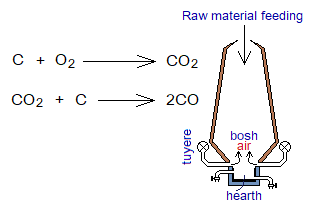
- Reduction of iron oxide: The ferric oxide of hematite ore is reduced to iron by carbon monoxide gas in vertical, tall section of the furnace, called stack; located above bosh. The iron formed in the molten state; and is collected in hearth. It is then tapped off (drained out) through a nozzle from the furnace. Hearth is at very high temperature; so is the name, meaning fireplace or a floor from where fire is given.
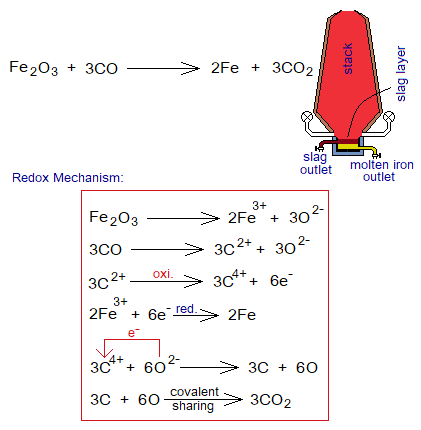
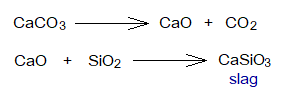
- Thermal decomposition of limestone: The CaCO3 decomposes into calcium oxide and CO2. This decomposition also takes place in stack section.
- Formation of slag: The CaO reacts with silica (SiO2: sand impurity) to form slag of calcium silicate (CaSiO3). A slag is a leftover / waste material; as it is unwanted for blast furnace processing; but could be used anywhere else. It is formed at bosh region. It floats on the surface of molten iron as a separate layer, and tapped off through a different nozzle. This nozzle is mounted above to the nozzle for draining out the molten iron.
Bauxite Ore:
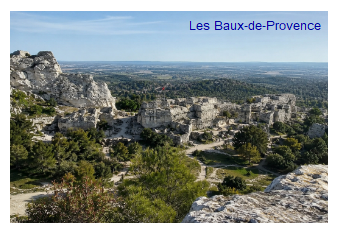
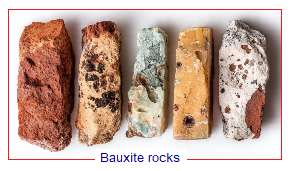
The metal aluminium (also aluminum) is found in highest proportion (8.1 % by mass) on earth crust. Iron is 5 %; calcium 3.6 %; sodium 2.8 %; potassium 2.6 %; and magnesium 2.1 %. The bauxite ore is used in the metallurgy of aluminium. It was discovered in 1821 by a geologist Pierre Berthier (1782 – 1861). He given the name bauxite on the name of the region ‘Les Baux’ located at Southern France in Alpilles mountains. The colour of the stone is reddish-brown, pale yellowish (tan) to white, and even green due to the presence of impurities; and there is no luster in its appearance. Bauxite is consisted of a number of various minerals; however, there are three of aluminum in hydroxide forms. The aluminum is 25 % or more in various bauxite ores.
Treatment of Bauxite Ore:
- The crushed ore is dissolved in hot concentrated NaOH. The impurities, like sand and iron oxide, don’t dissolve; and thus, filtered off.
- The aluminum hydroxide [Al(OH)3] reacts with NaOH to form sodium aluminate {Na[Al(OH)4}; which is diluted with excess of water, and heated at high temperature to form pure aluminum oxide, called alumina. This alumina is used for the extraction of aluminum.
Extraction of Aluminum:
For the smelting of aluminum, an industrial process of electrolysis was developed independently by Charles Martin Hall (1863 – 1914), an American chemist and Paul Heroult (1863 -1914) a French scientist. This is the reason that the method is called Hall-Heroult Process.
Design of the Cell:
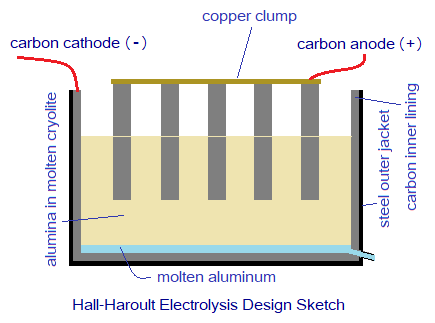
The electrolysis cell designed by Hall & Heroult is a steel tank consisted of the following parts:
- Having an inner lining of carbon connected with cathode (-ive terminal).
- The carbon rods connected with anode (+ive terminal). These rods are dipped in molten cryolite containing dissolved purified alumina.
- The electrolysis is carried out by supplying the current more than 15 kWh.
Process & Reactions:
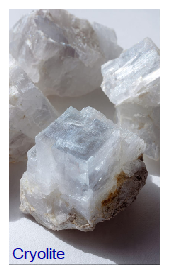
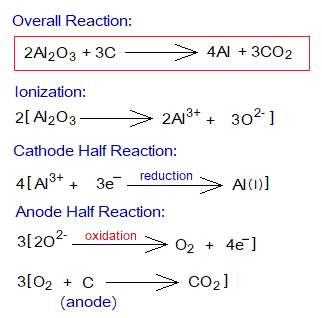
- The pure alumina (Al2O3) is dissolved in molten cryolite (Na3AlF6); and the tank is filled with this mixture. Importance of Cryolite: The solvent cryolite lowers the melting point of alumina from 2050°C to 950°C; thus, it is economical by means of energy consumption.
- At positive terminals (anode), the oxide ions (O2-) are oxidized into oxygen molecule. These electrons are used in reduction.
- At negative terminal (cathode), the reduction of Al3+ takes place by 3 electrons to produce liquid aluminum. It is drained out into ladle.
- The O2 molecules produced, react chemically with carbon of anodes; resultantly CO2 gas is produced, and anode is consumed. Thus, there is a need to replace anodes regularly.
Fascinating Information:
Cryolite is a mineral of formula Na3AlF6, sodium hexafluoroaluminate. Its melting point is 1012°C and the colour is mostly white; however, black, brown or red shades are also available but rarely found.