Dr. Mudassar Altaf, Associate Professor of Chemistry, Department of Higher Education, Government of the Punjab, Pakistan
Contents:
- Softness/ harness of alkali metals
- Melting points of alkali metals
- Densities of alkali metals
- Experiment to measure density of sodium metal
- Appearances of alkali metals
- Chemical reactivities of alkali metals
- Alkali Metals reactivity with water
- Appearances of alkali metals hydroxides
- Alkali Metals reactivity with oxygen: Normal oxides, peroxides, superoxide
- Alkali Metals reactivity with halogens
- Appearance of alkali metals halides (salts)
- Overall trends of the IA-group
Softness/ Harness of Alkali Metals:
Alkali metals exist at extreme left column of the periodic table and recognized as IA group. These are soft metals and can be cut with knife. Their hardness can be measured by Mohs scale, was developed by a German Carl Friedrich Mohs in 1812 and described in the link https://chemiologist.com/arrangement-of-elements/ .
The hardness of IA metals decreases down the group; in other words, softness increases from first metal, lithium, to the last metal, the francium. On Mohs scale the values are as under:
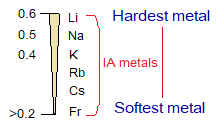
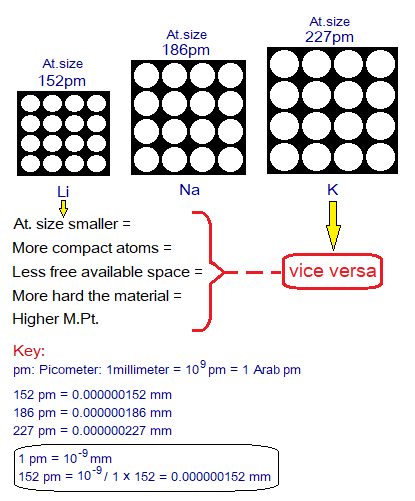
More the atomic size smaller, more compact the atoms will be packed; as a consequence, making the overall material harder.
Melting Points of Alkali Metals:
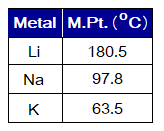
The melting points of these metals show a decreasing trend down the group, Li to Fr; shown in the table below. Lithium has the highest melting point. More a metal harder, more will be its melting point; and vice versa.
Densities of Alkali Metals:
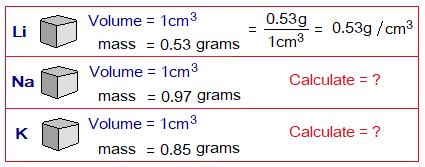
The density is measured by mass (grams or kilogram) per unit volume. Formula for the calculation of density is: mass / unit volume. In other words, to a fixed volume, it is a measurement of mass. Suppose the unit volume is 1 cm3,then, the mass in grams of a particular metal occupying that unit volume is measured. So, the first focus is unit volume, then is mass. Densities of lithium, sodium & potassium given below in the table. So, density increases down the group; due to increase in atomic mass.
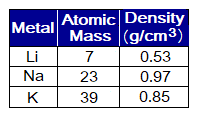
Although, the volume of the following metals is same (1 cm3), but they are not equal with respect to masses due to differences in their atomic masses.
Experiment to Measure Density of Sodium Metal:
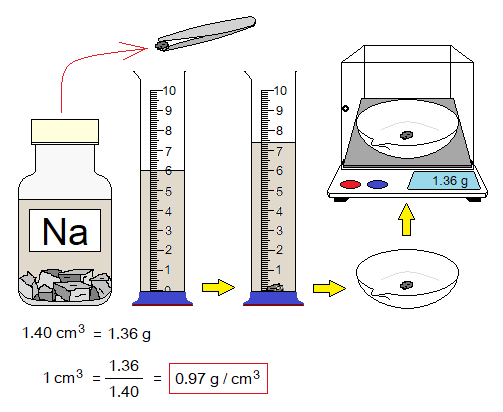
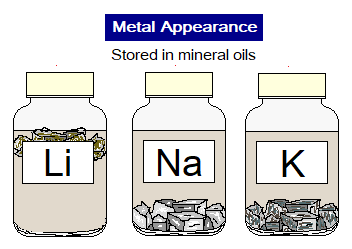
Alkali metals are very reactive with moisture and the air (O2); and can even ignite. Thus, these are stored in kerosene oil. The experiment will follow the following steps:
- Take a measuring cylinder of 10 cm3. Roughly, fill it half with kerosene oil, say 6.0 cm3.
- Now, drop a smaller piece of sodium metal from the stock bottle in the cylinder and note the rise of the liquid volume. Suppose, it is 7.4 cm3. So, the volume of the metal piece will be 1.40 cm3 (7.4–6.0=1.4). Don’t touch metal piece but use a forceps.
- Take sodium metal out of kerosene oil using forceps. Place the metal in a completely dry China dish and allow it to dry. To avoid a sudden explosive reaction, the metal is kept away from water.
- Then weigh the piece by digital balance. Suppose, it is 1.36g.
- Calculate density of sodium metal by the following way using unitary formula:
Appearances of Metals:
Li: With grey shade, the metal appears in silvery-white, floats on the surface of mineral oil. The shiny surface becomes dull in air slowly. Slightly harder to others two metals.
Na: Silvery-white, and sinks at the bottom of mineral oil. The shiny surface becomes dull in air quickly. It is soft like a cake.
K: With bluish (lilac) shade, the metal is silvery in its appearance. The shiny surface becomes dull in air more quickly than Na. It is softer than Na.
Chemical Reactivities of Alkali Metals
These metals are very reactive by their nature due to higher electropositive character; because of the reasons:
- larger atomic size in their period
- only single electron exists in outermost shell (OMS)
- lower the ionization energy (I.E.) to make cations by oxidation [M→M++e–]. Li I.E:520 kJ/mol; Na: 496 kJ/mol; K: 419 kJ/mol.
The reactivity order is: Li<Na<K. Among them, the potassium is more reactive due to larger atomic size and lower I.E. and thus easier for it to remove electron of OMS to make K+.
Reactivity with Water:
The alkali metals react vigorously with water, yield hydrogen gas and metal hydroxides. All metals show exothermic reactions.
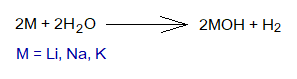
Potassium shows violent reaction and hydrogen often catches fire. Sodium shows less vigorous as compared to K. However, lithium doesn’t show vigorous reaction due to low on the reactivity order.
Appearances of MOHs:
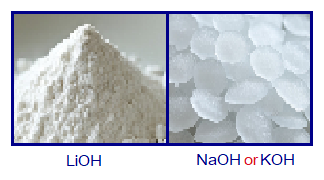
- LiOH:White crystalline solid. It is hygroscopic in nature, i.e., absorbs water from atmosphere but remains solid. Its aqueous solution is colourless.
- NaOH (caustic soda):White flakes or pellets, deliquescent in nature, i.e., absorbs water from atmosphere and dissolved in it to form solution. Its aqueous solution is colourless.
- KOH (caustic potash):White flakes or pellets, deliquescent in nature, i.e., absorbs water from atmosphere and dissolved in it to form solution. Its deliquescent property is greater than NaOH. Its aqueous solution is also colourless.
Reactivity with Oxygen:
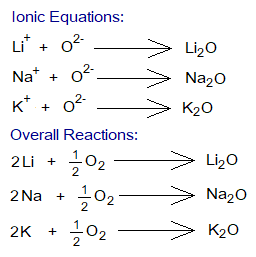
Lithium shows relatively slow reaction with oxygen; while sodium and potassium show vigorous. These are the metallic oxides; and are basic in nature. Because, react with water to form metal hydroxides [Na2O+H2O→2NaOH]. There are three types of oxides the alkali metals form. These are:
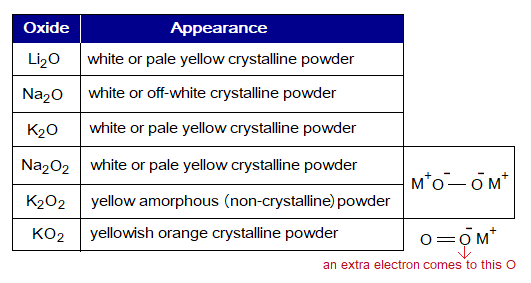
- Normal oxides: M2O; where the oxidation state of oxygen is as usual, i.e., -2. Lithium, sodium and potassium, all form normal oxides as Li2O, Na2O, K2O. All the metals are unipositive (M+).
- Peroxides: M2O2; where the oxidation state of oxygen is -2 but by a diatomic oxygen molecule (O-O)-2 or O2-2. For example, Na+ & K+ oxides (Na2O2; K2O2).
- Superoxide: MO2; where the oxidation state of oxygen is -1 but by a diatomic oxygen molecule (O=O)– or O2– carries 1 extra electron and attaining negative charge. For example, potassium oxide (KO2).
Reactivity with Halogens:
Alkali metals form ionic compounds (salts) with halogens. The order of reactivity is Li<Na<K. So, going down the group, the reactivity with halogens increases. Lithium is least reactive; while K is more reactive among these three metals. On the other hand, the order of reactivity of halogens decreases down the group by F2>Cl2>Br2>I2.
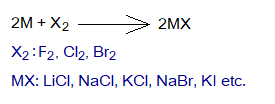
- These are highly exothermic reactions.
- Appearance: Almost all salts are white crystalline solids in pure form, like table salt (NaCl: sodium chloride).
- The anions are called halides not halogens. Thus, these are fluoride (F–), chloride (Cl–), bromide (Br–), and iodide (I–). For salts, click the link https://chemiologist.com/salts-their-preparation/ .
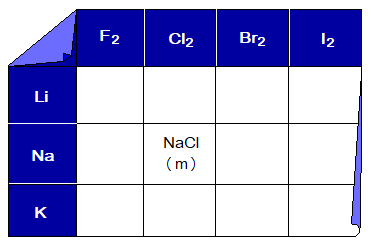
Exercise 1:
- Write the formula of ionic compounds in the boxes.
- By using order of reactivities of halogen molecules and metals, also predict the speed of the chemical reactions during the synthesis of a particular ionic compound. Use the scale: slow (s), moderate (m), vigorous (v), violent (vt). To understand the task one box has been filled for NaCl.
Overall Trends of the Group:
- Atomic Size: The atomic size increases down the group. Li = 152 pm to Fr = 270 pm.
- Atomic Masses: The atomic mass increases down the group. Li = 6.94 atomic mass unit (a.m.u). to Fr = 223 a.m.u.
- Electronic Configuration of OMS: Although, the outermost shells are different; however, these are occupied by one electron only in all elements of IA group. In other words, these are similar with respect to electronic configuration of OMS.
- Density: The density increases down the group due to increase in atomic mass. Li = 0.53 g/cm3 to Fr = 2.5 g/cm3.
- Hardness: The hardness decreases down the group. According to Mohs hardness scale the values are Li = 0.6 to Cs = 0.2. In other words, softness increases down the group. Li is like a rusk, Na and K are as soft as a cake; K is relatively softer than Na. Rb is like a cream; and Cs is as soft as a thick syrup. Francium is radioactive and by the group trend, it is expected to be the extreme soft metal of the group. Mohs scale has no unit.
- Ionization Energy: The ionization energy (I.E.) to remove the electron of OMS decreases down the group. Due to increase in atomic radii, the nuclear pull reduces on OMS as going down. Thus, it is easier for elements exist on the bottom to release OMS electron. Li = 520 kilojoules per mole to Cs 376 kJ/mol.
- Electropositivity: Electropositive character increases down the group. Less is the I.E. stronger will be the electropositive character [M→M++e–]
- Salts’ Formation: The electropositive metals (cations) make salts (ionic) with halides (X–: the anions of halogens), e.g., NaCl, NaBr, KCl, KI etc. Because, reactivity of metals increases down the group. On the other hand, reactivity of halogens (X2) decreases down the group. Thus, RbF, CsF salts are formed by vigorous reactions between more reactive alkali metals and more reactive halogen, F2. Although, the reaction of Li with F2 is exothermic, but not as violent as the metals Rb & Cs show. Likewise, RbI and CsI also exists.
- Oxides: These are acidic oxides. They form normal oxides (M2O); peroxides (M2O2); and superoxides (MO2).
- Reactions with Water: As the reactivity of alkali metals increases down the group, thus, Li show slow reaction with water, while Cs show extremely violent. Na show fast, K very fast, Rb vigorous. By the chemical reactions, hydroxides (MOH) and hydrogen gas are produced.