Dr. Mudassar Altaf, Associate Professor of Chemistry, Department of Higher Education, Government of the Punjab, Pakistan
Contents:
- Periodic table: A brief introduction
- Why is it called the periodic table? And definition of modern periodic table
- Design of modern periodic table: Periods & groups
- Non-metallic versus metallic character
- Trend in metallic & non-metallic character
- Charges on the elements in group
- Electronic configurations of the groups
- Properties of alkali metals (IA)
- Interesting information related to alkali metals
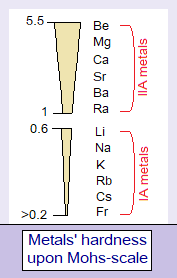
- Mohs scale of hardness
- Comparison of IA & IIA upon their reactions with water
- Comparison of oxides of IA & IIA
- Comparison of radii of IA & IIA
- Properties of halogens (VIIA)
- Displacement reactions
- Position of an element & prediction of its properties
- Trends in groups
Periodic Table: A Brief Introduction
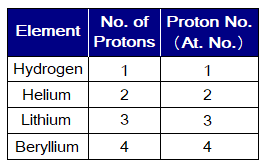
The modern periodic table is the arrangement of elements according to increase in their atomic number. The atomic number, also known as proton number, is the number of protons in an atom. Following table shows first four elements of the periodic table.
Why is it Called the Periodic Table?
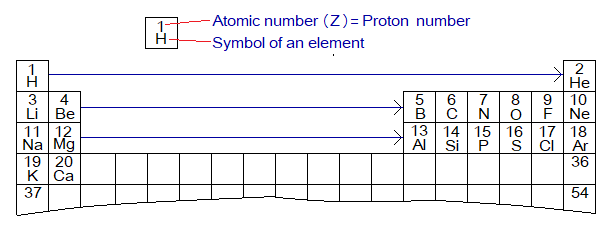
The word ‘Periodic’ means ‘something that repeats itself at regular intervals’; just like day & night, seasons, and likewise, the properties of elements are the periodic functions (periodic variation). So, by following the increase in elements’ atomic numbers from left to right, they are placed below the above having similar properties. So, the modern periodic table is defined as, “the elements are arranged according to increase in their atomic numbers, and their physical and chemical properties are the periodic function of these atomic numbers”.
In the following examples, Li, Na & K are placed in a single group due to common properties. Likewise, He, Ne, Ar are placed in another group due to having similar properties. Al is placed below to B; while Si is placed below to C; and think for all other elements placed in a group.
Design of Modern Periodic Table:
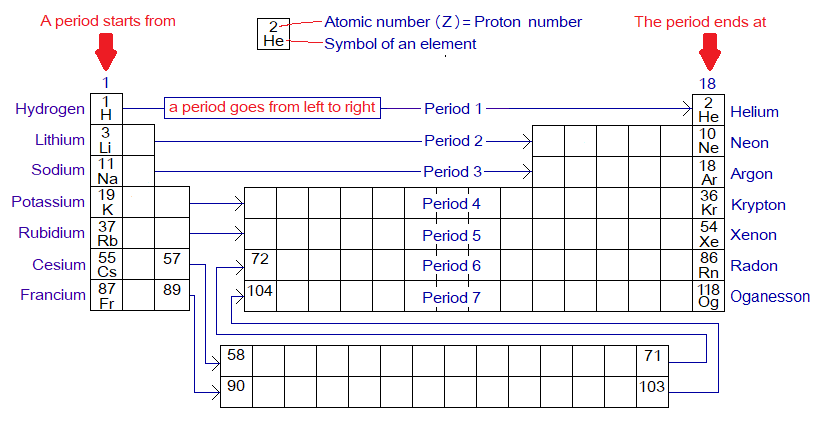
The periodic table is designed into periods & groups. The Periods are the arrangement of elements according to increase in their atomic numbers from left to right. The Groups are the arrangement of elements according to increase in their atomic numbers from top to bottom.
There are 7 periods in the table. The periods start from alkali metals (Li, Na, K, Rb, Cs and Fr) and end at noble gases (He, Ne, Ar, Kr, Xe, Rn, and Og). Hydrogen was placed at the top of alkali metals in initial design, but the position was changed in latter design and now placed separate.
- Period 1: It is called shortest period due to having just two elements, H & He.
- Period 2 & 3: These are called short periods due to containing 8 elements in each.
- Period 4 & 5: These are called long periods, containing each 18 elements.
- Period 6 & 7: These are longest periods, containing each 32 elements.
Go through the following diagram to understand the concept.
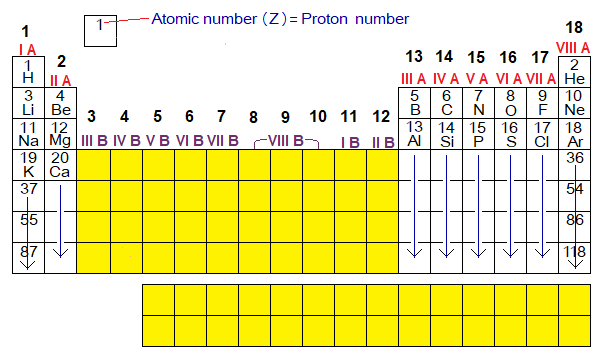
There are 18 groups in a total, these are:
- Group 1: Older Roman number is IA. These are alkali metals. Other than hydrogen, first three elements are, lithium (Li), sodium (Na), & potassium (K).
- Group 2: Roman number is IIA. These are alkaline earth metals. First three elements are, beryllium (Be), magnesium (Mg), & calcium (Ca).
- Group 3 to 12: Roman numbers: IB to VIII B (yellow boxes in the following figure). These are transition metals. Few important elements are, copper (Cu), iron (Fe), cobalt (Co), zinc (Zn), mercury (Hg), silver (Ag), gold (Au), etc.
- Group 13: Roman number IIIA. This is boron family. Because, boron is the first member of the group, so, named accordingly. First two elements are, boron (B), & aluminum (Al, also aluminium). This group is also known as triels; because of 3 valency.
- Group 14: Roman number IVA. This is carbon family. First two elements are, carbon (C), & silicon (Si). This group is also known as tetrels; because of 4 valency.
- Group 15: Roman number VA. This is nitrogen family. First two elements are, nitrogen (N), & phosphorous (P). This group is also known as pentels; because of belonging to Vth group. This group is also known as pnictogen. The world ‘pnictogen’ has its Greek root; ‘pnigein’ means ‘to suffocate’; because nitrogen doesn’t support respiration.
- Group 16: Roman number VIA. This is oxygen family. First two elements are oxygen (O), & sulfur (S). This group is known as chalcogens. The ‘chalco’ is a Greek word, having its meaning ‘ore’. ‘Gen’ is also a Geek word, meaning ‘generation’. Because, oxygen and sulphur are the elements exist in ores.
- Group 17: Roman number VIIA. These are halogens. The ‘helo’ is Greek word, meanings ‘salt’. These elements are salt forming; for example, KBr, (potassium bromide is a salt). First four elements are, fluorine (F), chlorine (Cl), bromine (Br), & iodine (I).
- Group 18: Roman number VIIIA. These are noble gases. First three elements are, helium (He), neon (Ne), & argon (Ar). These are also known as zero group elements; because of zero valency.
Non-metallic Versus Metallic Character:
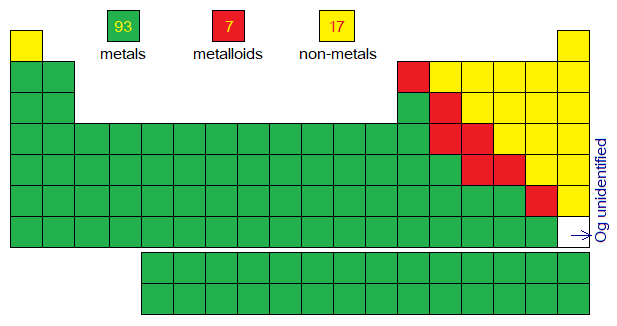
The metals are abundant among elements. There are 93 metals, 17 non-metals; while 7 elements behave like metals and non-metals and are called semi-metals or metalloids. Go through the following diagram of periodic table.
Trend in Metallic & Non-metallic Character:
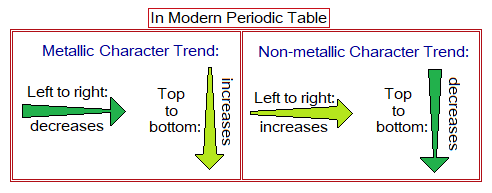
- Along the Period: The metallic character decreases from left to right along the period. In other words, non-metallic character increases.
- Along the Group: The metallic character increases down the group. In other words, non-metallic character decreases. That is the reason, why semi-metals are located in stair-steps (red boxes) in the table. Upper is non-metal, then below is semi-metal due to increase in metallic character down the group; and then comes the metals.
Charges on the Elements in Group:
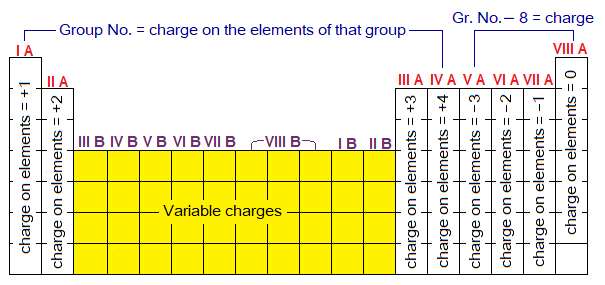
There are two groups A and B in the periodic table. B-block are transition metals and have variable charges (+1 to +7) depending upon the metal. Generally, the elements of A-block have their charges same as their group number from IA to IVA, as shown in the following figure. However, in groups V to VII, there is a subtraction of 8 from a relevant group number to know charges of the elements of that group; as shown below in the figure.
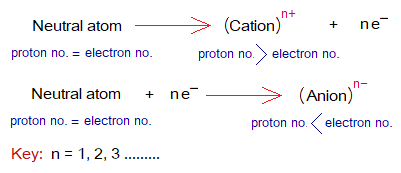
There are two types of charges, cations or anions. The positive charge is cation, when electron(s) is removed from neutral atom; making it an ion that would carry a positive charge. The negative charge is anion, when electron(s) is gained by a neutral atom; making it an ion that would carry a negative charge.
During a chemical change, the number of protons doesn’t change; but due to increase or decrease in the number of electrons of the outermost shell, the anion or cation is formed. For example, Na carries 11 protons & 11 electrons; but Na+ carries 11 protons & 10 electrons; so, mathematically, attains a positive charge. Similarly, F carries 9 protons & 9 electrons; but fluoride (F–) carries 9 protons & 10 electrons; consequently, attains a negative charge.
Electronic Configurations of the Groups:
The elements of a group have their similar electronic configurations of outermost shells (OMS). Keep in mind the maximum electrons that a shell can carry, K-shell 2, L-shell 8, and M-shell 18.
- Alkali metals (IA group): These elements have their OMS electronic configuration by just 1 electron.
1H = K1 This is not an alkali metal; however, it can be placed at the top of this group due to some similarities, and one of them is outermost shell electronic configuration.
3Li = K2, L1
11Na = K2, L8, M1
19K = K2, L8, M8, N1
- Alkaline earth metals (IIA): These elements have their OMS electronic configuration by just 2 electrons.
4Be = K2, L2
12Mg = K2, L8, M2
20Ca = K2, L8, M8, N2
- Boron family (IIIA): These elements have their OMS electronic configuration by just 3 electrons.
5B = K2, L3
13Al = K2, L8, M3
- Carbon family (IVA): These elements have their OMS electronic configuration by just 4 electrons.
6C = K2, L4
14Si = K2, L8, M4
- Nitrogen family (VA): These elements have their OMS electronic configuration by just 5 electrons.
7N = K2, L5
15P = K2, L8, M5
- Oxygen family (VIA): These elements have their OMS electronic configuration by just 6 electrons.
8O = K2, L6
16S = K2, L8, M6
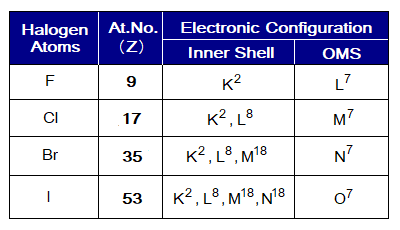
- Halogens (VIIA): These elements have their OMS electronic configuration by just 7 electrons.
9F = K2, L7
17Cl = K2, L8, M7
35Br = K2, L8, M18, N7
- Noble gases (VIIIA): These elements have their OMS electronic configuration by just 8 electrons, except helium.
2He = K2
10Ne = K2, L8
18Ar = K2, L8, M8
Properties of Alkali Metals (IA):
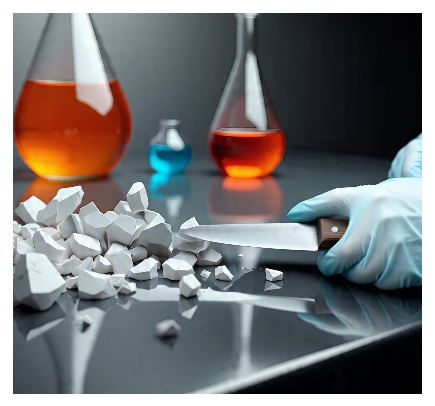
- These are all soft metals and can be cut with a knife easily. Pure metals are grey (silvery-white) in colour, like lithium, sodium, and potassium.
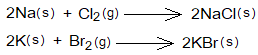
- These metals form ionic compounds, the white salts, with non-metals’ anions (chloride, bromide, iodide: Cl–, Br–, I– etc. respectively). For example, LiCl, NaCl, KCl, LiBr, NaBr, KBr etc.
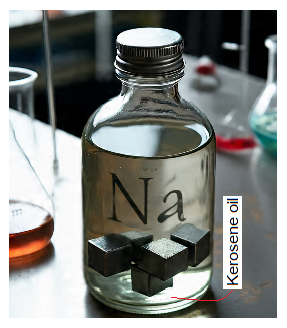
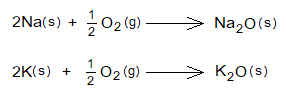
- The Na, K metals show violent reactions with oxygen of the air and the moisture; thus, can catch fire. So, these are stored in oils, like kerosene, mineral or paraffin. By the reaction with oxygen, the oxides are formed, has been discussed on the link https://chemiologist.com/properties-of-metals/ .
- These metals form alkalis and hydrogen gas by reacting with water. These reactions are vigorous and can ignite hydrogen gas. Because of the formation of alkalis with water, these are called ‘alkali-metals’.

Interesting Information Related to Alkali Metals:
- Lithium is the lightest metal among all other metals of the periodic table.
- Li, Na, & K have their densities below to the density of water (H2O=1.0g/cm3 at 4°C), so, float on water’s surface. However, rubidium (Rb) & cesium (Cs) have their densities above 1.0, thus, sink. Further, kerosene has its density lower to these metals; so, all metals sink in it.
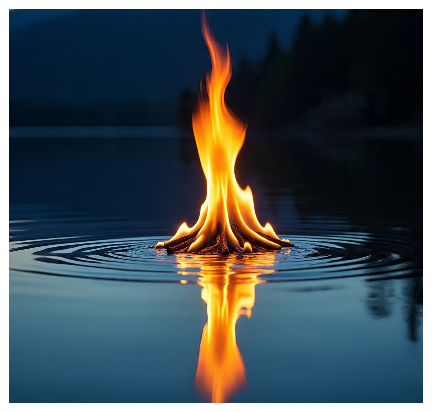
- When sodium metal is sprinkled over water surface, it vigorously shows an exothermic reaction and produces NaOH and hydrogen gas. The gas catches fire and even violent reaction can occur. The magicians do the same by setting the fire on water surface during their show, making the spectators astonishing.
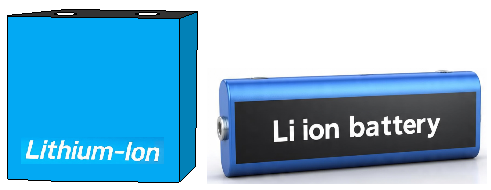
- Li nowadays a widely used metal in rechargeable batteries of smartphones, laptops, electric vehicles, calculators etc. Nowadays LiFePO4 batteries are widely used, because, these are safe and having very long life. However, these are costly.
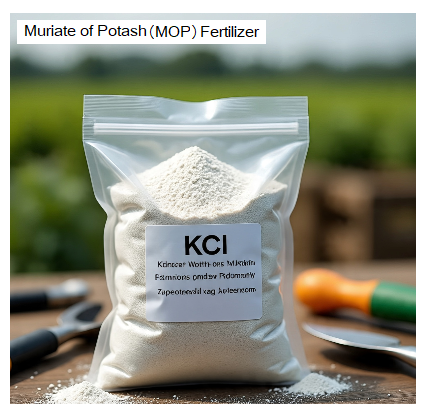
- Potassium is an essential component of the fertilizer. For example, KCl (potassium chloride) is a fertilizer and ‘muriate of potash’ is its common name.
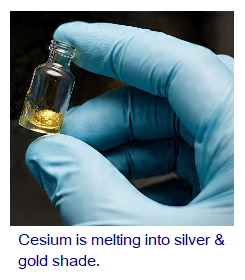
- Cesium and francium (Fr: radioactive metal) have their melting points below to 30°C; so, melt in summer season; even the melting point of Rb is 39.3°C.
- Sodium vapour lamps have long been used as street lights. Because, they produce a bright yellow light; and give a better visibility in dust, smog and fog. Further, a yellow light causes relatively less glare (a very shinning / bright light) as compared to white light. Glare means a blinding / dazzling light that makes uneasy to see clearly (dazzle) particularly while driving at night.

Fascinating Information: Mohs Scale of Hardness
It is interesting to know that a German mineralogist Carl Friedrich Mohs (1773-1839) developed a ten-point Mohs scale in 1812 to define the hardness of the minerals and metals. The lowest value is less than 1 and the highest value is 10 to quantify the hardness / softness of the material. The value depends upon the resistance against scratching.
- If a material can be cut easily with a cake knife like a cake, then, its value will be less than 1.
- If a material can be scratched with a finger nail easily, then, its value will be 2; or if more force is required then it would be 3.
- If a material can be scratched with a copper penny, then, its value will be 4.
- If a material can be scratched with a knife, then, its value will be 5.
- If a material can be scratched with an iron nail with force, then, its value will be 6 and if more force is required then would be 7.
- If a material can be scratched with a drill bit easily, then, its value will be 8; and if high force is required then it would be 9.
- The diamond is so hard, that cannot be scratched; so, its value is 10; the highest one.
Following is a comparison given between metals of IA & IIA group upon Mohs hardness scale. The diagram shows that alkali metals are more soft than alkaline earth metals. Further, in both groups, the hardness decreases down the group.
Comparison of IA & IIA upon their Reactions with Water:
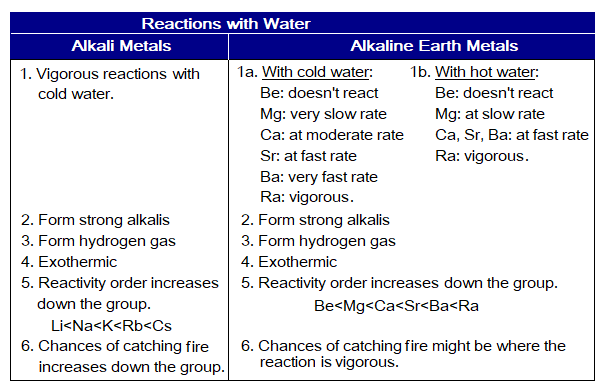
A general review is given below in the following table.
Comparison of Oxides of IA & IIA:
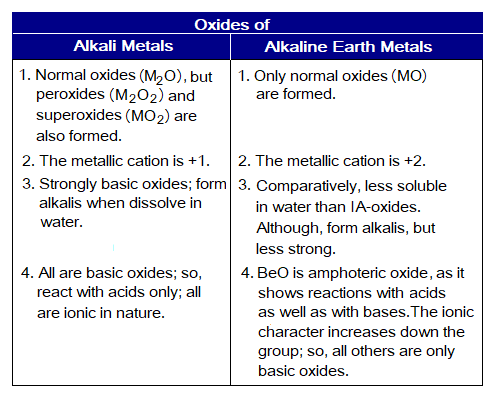
A general review is given below in the following table.
Comparison of Radii of IA & IIA:
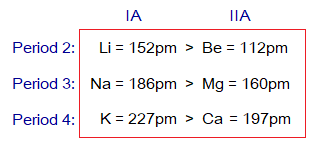
A general trend is that atomic radius decreases along the period (left to right); while, increases down the group. Following is a comparison given in picometer (pm).
- 1000 pm = 1 nanometer
- 1000 nanometer = 1 micrometer
- 1000 micrometer = 1 millimeter
- So, 1mm = 109pm.
A human eye has its capacity to see just to the minimum level of 0.1mm, approximately to a dust particle.
Properties of Halogens (VIIA):
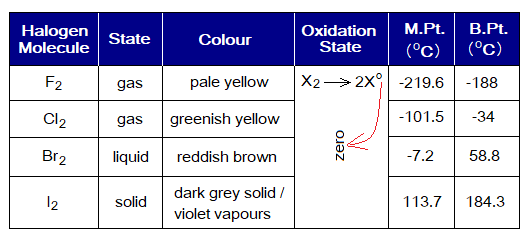
These are non-metals and exist in diatomic state (X2). Fluorine (F2) & chlorine (Cl2) are gases, bromine (Br2) is liquid, while iodine (I2) is solid; and have different colours as shown in the following table. The oxidation state (charge) on an atom is zero in their diatomic molecular state.
The electronic configuration of all halogen atoms is same in their outermost shells (OMS), having 7 electrons; and need 1 more to attain noble gas electronic configuration, a stable one.
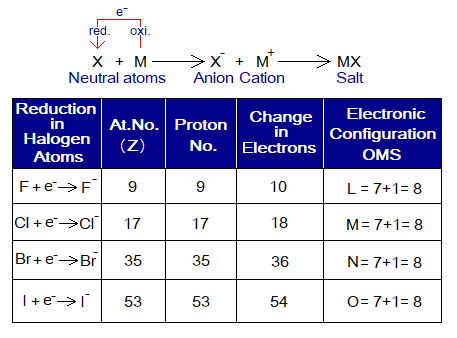
The halogen atoms form halide anions by reduction. So, these act as oxidizing agents.
- Fluorine forms fluoride ion by reduction, i.e., by gaining 1 electron.
- Chlorine forms chloride ion by reduction, i.e., by gaining 1 electron.
- Bromine forms bromide ion by reduction, i.e., by gaining 1 electron.
- Iodine forms iodide ion by reduction, i.e., by gaining 1 electron.
Halogens need electron for reduction. Hence, cause the metals to oxidize by losing electron.
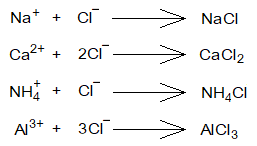
The -1 charge of halide ions form salts with metallic cations and the ammonium a non-metallic cation. For instance, the formation of sodium chloride, calcium chloride, ammonium chloride and aluminum chloride salts.
Displacement Reactions:
These reactions have also been discussed in the link 8.3. Halogens show reduction by gaining of electron, and attain negative charge. Among halogens (X2), the order of reduction potential is highest at the top of VIIth group, i.e., at F2 and lowest at I2.
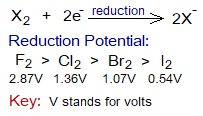
The fluorine will like to reduce at greater potential as compared to chlorine. This is the reason that F2 can show its replacement reaction with NaCl to form NaF. But Cl2 will not displace fluoride from NaF, and the reaction will not occur. Because, chlorine will not like to reduce when there is fluorine due to lower reduction potential. Go through the following step-by-step reactions, and understand the concept.
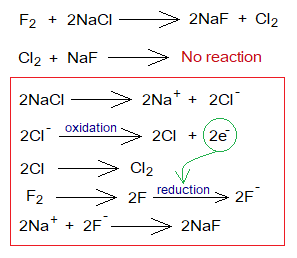
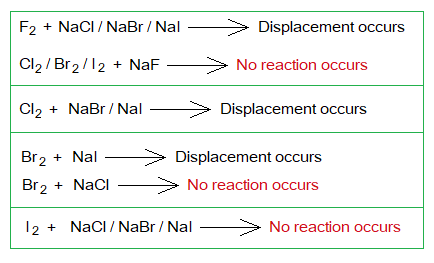
Keep in mind, the reduction potentials, and grasp the concept deeply related to the following displacement reactions.
Position of an Element & Prediction of its Properties:
Each element is recognized by its position on the periodic table. To which group and period, a particular element belongs is a key concept to know its chemical and physical properties. For example, let’s see the example of sodium. It belongs to alkali metals. So, its properties will be similar to that group, like electronic configuration of outermost shell, atomic radius, metal or non-metal, trend towards making cation or anion, trend towards making covalent bond, ionic-covalent or ionic bond, trend towards oxides formation, halides formation, nitrides formation, nitrates formation, carbonates formation, etc. So, many other characteristic properties can be predicted on the basis of its position on the periodic table. Further, there is also a variation or particular trend of properties of that element; and a trend of variation along the period or the group will be helpful to understand.
Trends in Groups:
There are various trends in a group that provide in-detail information related to a particular element. These are:
- Atomic size increases down the group.
- Metallic character increases down the group.
- Ionization energy decreases down the group. So, going down, it is easy for an atom to remove electron from its outermost shell, making a cation, and is a property of metals. Hence, metallic character increases down the group. It is due to increase in atomic size down the group.
- Melting & boiling points decreases down the group in alkali & alkaline earth metals. But it increases in halogens down the group.
- Density increases down the group due to becoming heavier the atoms as moving down along the group.