Dr. Mudassar Altaf, Associate Professor of Chemistry, Department of Higher Education, Government of the Punjab, Pakistan
Contents:
- Elements of group-VII: An introduction of halogens
- Physical states & densities
- Chemical reactivities of halogens:
- Oxidizing agents,
- Displacement reactions,
- Reactions with H2 to produce acids
- Overall trends of the group
Elements of Group-VII:
The elements of group VII are called halogens. This group is the penultimate (2nd last) column of the period table and consisted of fluorine (F), chlorine (Cl), bromine (Br), iodine (I), astatine (At), and Tennessine (Ts) elements. Further discussion will not be related to astatine & tennessine.
The etymology of halogen has been discussed in arrangement of elements . These are salt forming elements when are in anionic forms; fluoride (F–), chloride (Cl–), bromide (Br–), and iodide (I–). The halogens are non-metals and formed in the form of diatomic gases (F2, Cl2, Br2, I2)during chemical reactions.
Fascinating Information:
- The Ts, atomic number 117, is the penultimate element discovered in 2010; the last one is a solid oganesson (Og), atomic number 118 and belongs to noble gases group. Ts is semi-metallic, solid, superheavy and synthetic element.
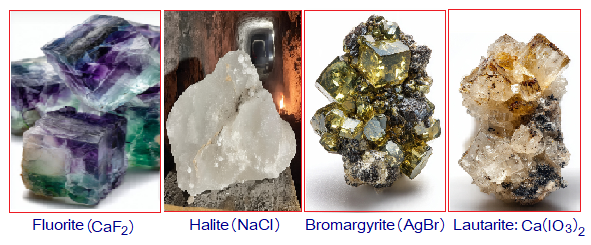
- Naturally, the halogens don’t exist free, but in the form of minerals with metals, a few common examples are:
- Fluorite is a rock of calcium fluoride, exist in many colours together. It is the most colourful rock of the world. The colours glow under ultraviolet light with fluorescence. The colours are yellow, blue, green hue, white, purple, and even colourless.
- Halite is a rock of sodium chloride (table salt, rock salt). It also exists in many colours due to impurities. The colours are white, colourless, pink, yellow, grey and even black.
- Bromargyrite is a rock of silver bromide. It exists in pale-yellow, grey and even green shade.
- Lautarite is a rock of calcium diiodate. It is white, colourless, and various hues of yellow.
Physical States & Densities:
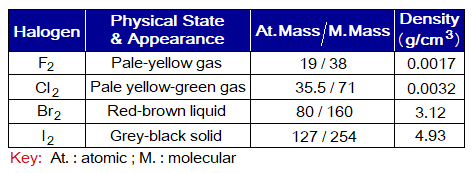
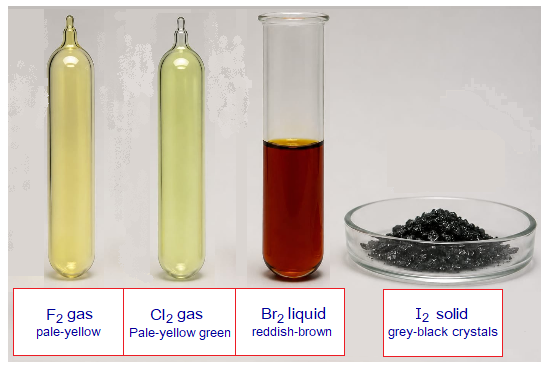
- Fluorine and chlorine are gases, bromine is a liquid, while iodine is a solid. They have characteristic colours, summarized in the table below.
- The densities of diatomic molecules in the unit g/cm3 are given in the table below. Density exhibits an increasing trend down the group because of increasing the molecular masses, as shown below.
Chemical Reactivities of Halogens:
Halogens (X2) have their chemical reactivities in the order of F2>Cl2>Br2>I2.Hence, F2 is most reactive, while I2 is least in the group.
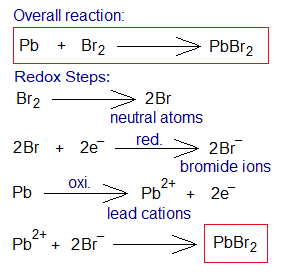
- The halogens are good oxidizing agents and need to gain 1 electron in their outermost shell to complete their octet according to noble gas electronic configuration (the stable one). So, metals are oxidized and provide electrons to halogen atoms for reduction. Thereafter, an ionic bond is established between metal cation and non-metal anion to form salt. The following example elaborates lead bromide salt formation.
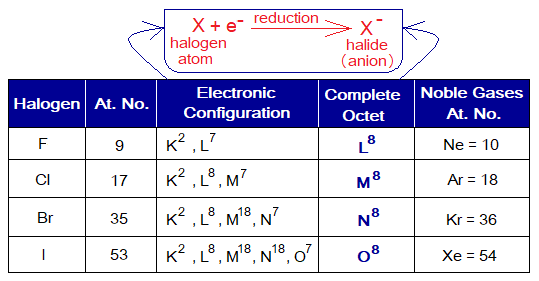
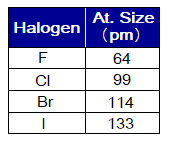
Due to smaller atomic size of fluorine atom, it is strongest oxidizing agent in the group. It is easier for fluorine atom to gain electron because of greater nuclear electrostatic forces of attractions. So, it has greater electron affinity. Further, fluorine atom has its highest electronegativity value, 4.0, among all elements, on Pauling scale (E.N. value has no unit). Iodine has its E.N. 2.6.
Exercise 1:
Why iodine (I2) is least reactive in its group? Answer the question in terms of atomic size, as an oxidizing agent, and electron affinity.
- Displacement Reactions: This topic has been discussed in link arrangement of elements . The reduction potential is highest in F2, while lowest in I2, as shown below.
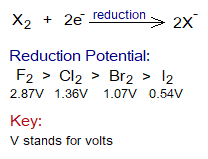
Chlorine has lower reduction potential to fluorine. Thus, F2 will like to reduce more into fluoride ion instead of chlorine. Resultantly, chloride ion will be displaced by fluoride to form NaF. It should be noted that there will be no chemical reaction between Cl2 and NaF. Following step by step elaboration of redox mechanism is given that describes how oxidation-reduction occurs.
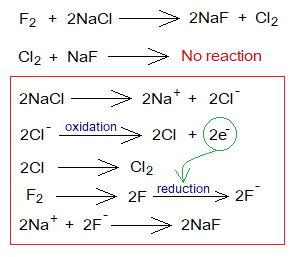
Following reactions show where displacement occurs and where it does not. To understand the concept, keep in view the reduction potentials given above in volts
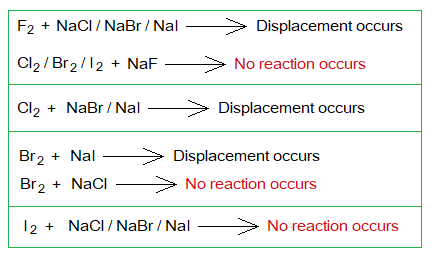
- In general, the diatomic molecule of upper element can show displacement of the halide ion from a salt that belonging to the halogen lower to that in the group.
- In general, the diatomic molecule of lower element can’t show displacement of the halide ion from a salt that belonging to the halogen upper to that in the group.
In general, the diatomic molecule of upper element can show displacement of the halide ion from a salt that belonging to the halogen lower to that in the group. The diatomic molecule of lower element can’t show displacement of the halide ion from a salt that belonging to the halogen upper to that in the group.
- Halogens react directly to hydrogen making mineral acids, HF, HCl, HBr and HI. Hydrogen and halogen, both need 1 electron to complete their outermost shell electronic configuration. So, both share their electrons to make a covalent bond. However, due to less electronegativity (E.N.) of hydrogen, the shared pair of electron slides more towards halogen; creating partial (slight, not true or complete) positive charge on hydrogen and partial negative charge on halogen, as shown in the following diagram. On Pauling scale, the E.N. of hydrogen is 2.20; while halogens 2.67, 2.97, 3.16, 4.0 for I, Br, Cl and F respectively.
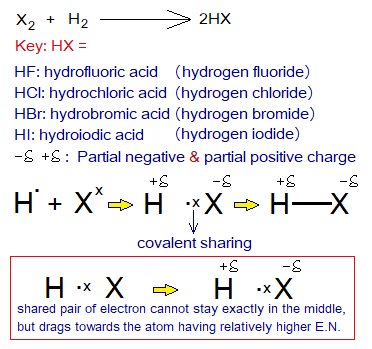
The bond strength is in the order of HF>HCl>HBr>HI; while acidic strength is in the order HF<HCl<HBr<HI. So, HF is a strongest bond but weakest acid; while HI is a weakest bond but strongest acid. The dissociation energy of HF bond is 566 kJ/mol; while it is 299 kJ/mol for HI bond. An acid is that which donates hydrogen ion in the aqueous solution according to Arrhenius acid definition proposed in 1884. Hydroiodic acid dissociates easily and releases H+ ion in the solution, thus, behaves as strong acid; and vice versa [HX+H2O→H3O++X–].
Overall Trends of the Group:
- Atomic Size: The atomic size increases down the group. F = 64 pm to I = 133 pm; so, by this trend At is larger in size to iodine and Ts is larger in size to At.
- Atomic Masses: The atomic mass increases down the group. F = 19 atomic mass unit (a.m.u). to I = 127 a.m.u. Hence, by this trend At has its atomic mass larger to iodine and Ts has greater mass to At.
- Electronic Configuration of OMS: Although, the outermost shells are different; however, there is deficient only single electron in all the elements of VIIA group. In other words, these are similar with respect to electronic configuration of OMS. Therefore, to attain noble gases electronic configuration, they show reduction by one electron and become uninegative ions (monovalent anions; [X+e–→X–]. It is the reason that they behave as oxidizing agents and in the order of the strength F2>Cl2>Br2>I2. For the last two elements, it can be predicted that it would follow the trend in this order F2>Cl2>Br2>I2>At>Ts.
- Density: The density increases down the group due to increase in atomic mass. F2 = 0.0017 g/cm3 to I2 = 4.93 g/cm3. So, Astatine will have its density above to iodine and Tennessine is predicted above to At in this sequence.
- Physical States: Above two are gases (F2 & Cl2), then bromine is a liquid, and below to that are solids.
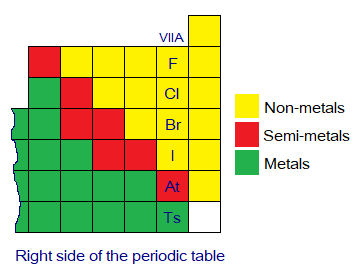
- Non-metals / Metals: metallic character increases down the group. Fluorine to iodine are non-metals; At is semi-metal (metalloid), while Ts is expected to be a metal.
- Electronegativity: Halogens are electronegative non-metals. On Pauling scale F has its E.N. highest among all elements and that is 4.0. It reduces down the group, and iodine has 2.67. Hence, it can be predicted that At will have its value lower to iodine and Ts lower to At.
- Salts’ Formation: Halide ions make salts with metallic cations, for instance, NaF, KBr, CaCl2, MgI2 etc. Fluoride makes least ionic. The ionic strength of salts increases down the group; so, iodide makes strong ionic salts and this trend can be predicted to be increased further down the group to the Ts.
- Acid Formation: Halogens form acids when react with H2; HF, HCl, HBr, HI. So, it can be expected that HAt and HTs might also be formed. Further, their acidic strength follows HF<HCl<HBr<HI and thus to the end it might be HF<HCl<HBr<HI<HAt<HTs. The bond strength might be expected to the end of the group in the order of HF>HCl>HBr>HI>HAt>HTs.