Dr. Mudassar Altaf, Associate Professor of Chemistry, Department of Higher Education, Government of the Punjab, Pakistan
Contents:
- Position of noble gases on periodic table
- Electronic configuration
- Monoatomic gas atoms
- Natural existence
- Densities & melting points
- Appearance
- Inertness of noble gases
Position of Noble Gases on Periodic Table:
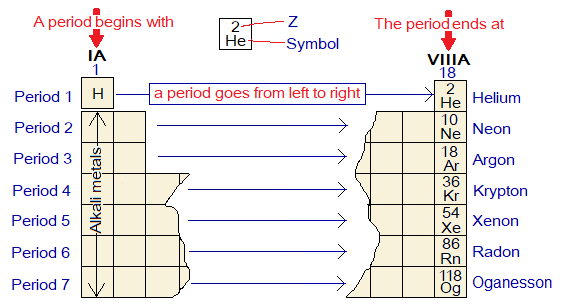
There are 18 columns in modern periodic table; and noble gases are located in group 18 (VIIIA), at the extreme right side. In other words, each period ends at noble gas. For more information, visit the link electronic configuration of noble gases.
Electronic Configuration of Noble Gases:
- All noble gases have their stable electronic configuration.
- They do not need to share electrons, or to make cations or anions. Whereas, all other elements follow their electronic configuration and share electrons, or make ions.
- The atomic numbers 2, 10, 18, 36, 54, 86 are stable by means of number of electrons in the orbits, sub-orbits. In other words, noble gases are stable atoms. They exist as monoatomic gas atoms (aka elemental gases). These are independent atoms and do not need to exist in the form of any kind of chemical bonding.
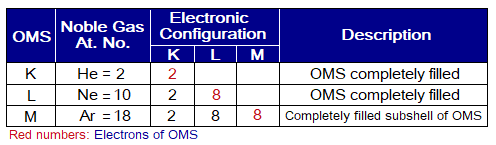
- Helium has its K-shell, the only shell, completely filled by 2 electrons, so, fulfills duplet rule.
- Neon has its completely filled L-shell, the outermost shell (OMS), so, fulfills octet rule.
- All other noble gases have their subshells of OMS completely filled, so, they fulfill octet rule.
Natural Existence:
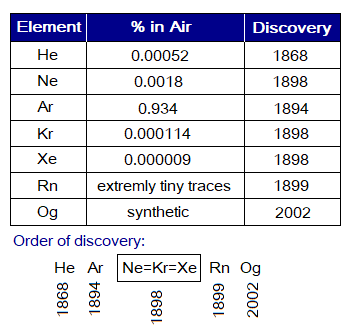
These gases exist naturally in air but their percentage of existence is extremely low as shown in the following table.
Densities & Melting Points:
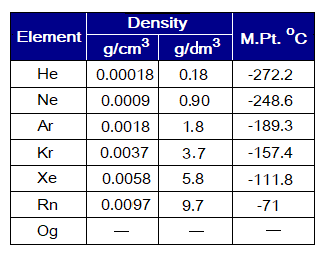
- Top to the bottom in vertical column, the density increases.
- In vertical columns of the groups, the melting point increases; although, all the values are very low due to gases.
Appearance:
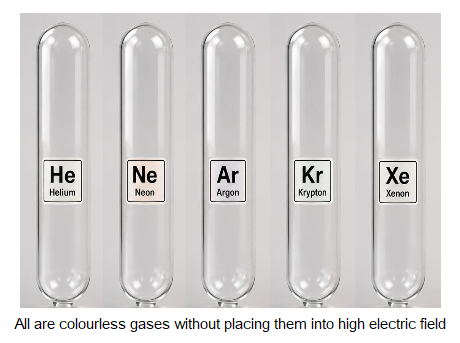
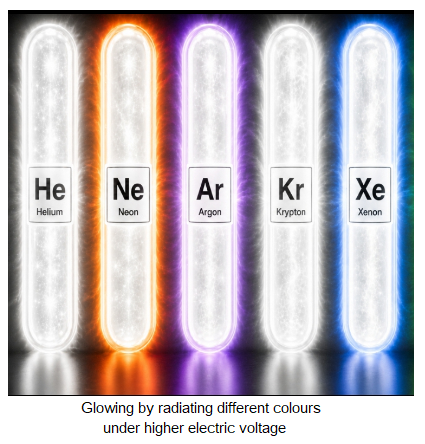
- These are odourless gases; but under high electric voltage radiate different colours as:
- The helium radiates grey light.
- The neon radiates orange-reddish light.
- The argon radiates violet light.
- The krypton radiates white light.
- The xenon radiates blue light.
Inertness of Noble Gases:
Because of having the stable electronic configuration, they are chemically inert. So, they exist in the form of monoatomic atoms.
However, under special conditions, they show chemical reactions.
- Their chemical reactivity is in the order of: He<Ne<Ar<Kr<Xe<Rn.
- Helium and neon are completely inert. Xenon forms many compounds; radon is radioactive element.
- It was discovered that argon forms compounds but unstable. For example, argon fluorohydride (HArF) is unstable compound discovered in 2000, and was formed at -265°C.
- Xenon forms various compounds with F2; likexenon difluoride (XeF2), xenon tetrafluoride (XeF4), xenon hexafluoride (XeF6). Also, xenon trioxide (XeO3), xenon tetraoxide (XeO4).
- Likewise, krypton also forms krypton difluoride (KrF2) with F2.