Dr. Mudassar Altaf, Associate Professor of Chemistry, Department of Higher Education, Government of the Punjab, Pakistan
Contents:
- Transition elements: brief introduction
- Features of transition elements, such as:
- Melting points
- Densities
- Variable oxidation states. How oxidation state is measured?
- Coloured compounds of transition elements
- Transition elements & their compounds as catalysts
Transition Elements: Brief Introduction
The metals located between the right- and left-hand sides of the periodic table are transition elements. These groups are recognized by the numbers 3 to 12 (IB to VIIIB) and placed in B-block, the yellow boxes, as shown in the following diagram.
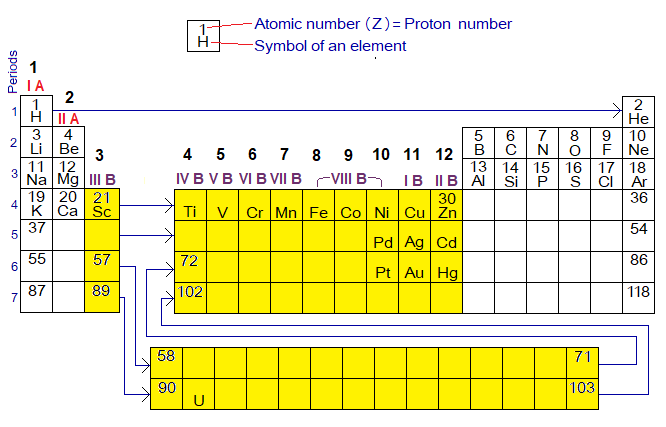
Transition means ‘going across’ from metals to non-metals. IA & IIA groups are strong metals, the metallic character still exists in transition elements but relatively low and ultimately the groups start by moving on the right side where non-metals are located. Transition metals belong to the periods 4 to 7 of the periodic table. The 4th period starts from scandium (Sc), atomic number 21; and ends at zinc (Zn), atomic number 30. There are 10 elements in this 4th period; further detail is as under:
- 4th Period: 10 elements
- 5th Period: 10 elements
- 6th Period: 24 elements
- 7th Period: 24 elements
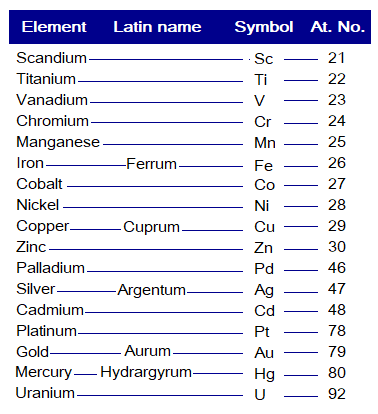
Few elements, their symbols and atomic numbers are given below:
Features of Transition Elements:
Few prominent features of these elements are:
- They have higher melting points.
- Their densities are higher.
- They have variable oxidation states.
- They form coloured compounds
- Their compounds or elemental forms are used as catalysts.
Melting Points:
Let’s have a discussion of 4th period in order to understand the trend of melting points of the transition elements. The m.pt. of Sc is higher to K and Ca. Then, it starts increasing gradually up to Cr; and falls suddenly at Mn the next one. Thereafter, the same trend is observed from Fe to Zn. A general trend shows that the melting points of transition metals is higher as compared to other metals in the period as the graph elaborates.
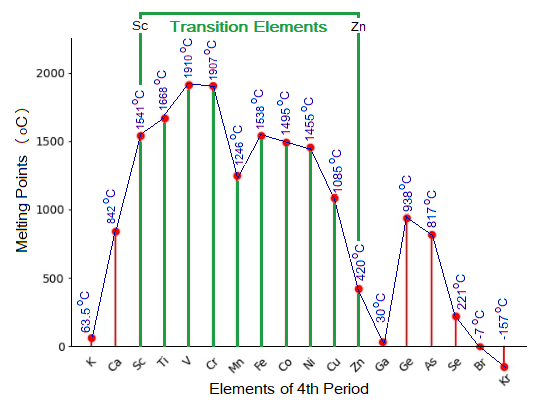
There is relatively a weak metallic bonding in Mn as compared to Cr & Fe; hence, its m.pt. is 1246°C, while Cr & Fe have higher of their values. The reason of weak metallic bonding in Mn has not been described here.
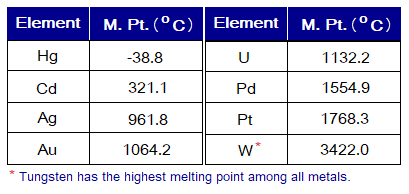
Melting points, of few other widely known transition metals of other periods, have been given in the following table in ascending order. They have higher m.pts. excluding Hg. Mercury has the lowest m.pt. among all metals.
Fascinating Information:
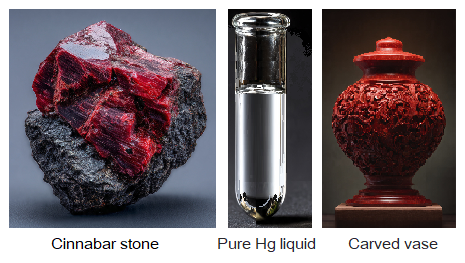
It is interesting to know that pure mercury is the only known metal that exists in liquid state at room temperature. Its ore (mineral) is cinnabar in the form of Mercury(II) sulfide, HgS. Its stone is reddish to brownish colour and had been used for making expensive decorative tiles, vases particularly in China etc; but due to toxicity, its use for this purpose has now been reduced.
Densities:
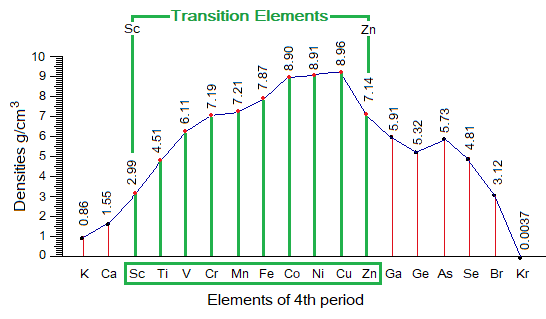
There is a general trend of 4th period that gradually density increases from left to right. However, Zn shows relatively lower value and this trend of lowering goes even to the end of the period. Arsenic (As) shows slightly higher to the trend going on. Krypton (Kr) is a monoatomic gas, so, having lowest density. A general trend is that the transition elements have higher densities.
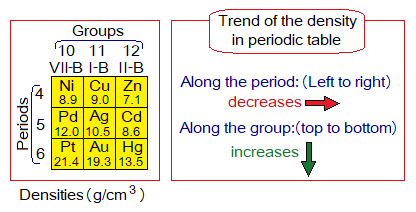
There is a general trend observed in selected groups (10, 11, 12) and periods (4, 5, 6) that:
- Moving along the period, left to right the density decreases.
- Moving along the group, top to bottom the density increases.
- However, there is irregularity towards the trend of increase or decrease in overall picture among transition elements. In other words, non-uniform trend exists on either side, along the period or group.
Variable Oxidation States:
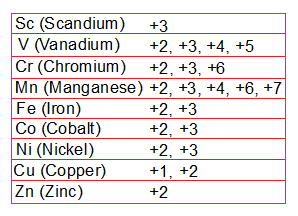
The transition elements exhibit variable oxidation states due to their ability to lose one or more electrons from their outermost shell as well as from the inner subshell. The detail has not been discussed here. Following are the examples given from 4th period. Sc & Zn show single oxidation state; while, Mn shows many.
Due to variable oxidation states, they have an ability to form various compounds. For example:
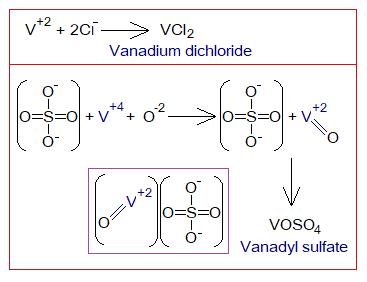
- V: V+2 forms VCl2; while V+4 forms VOSO4 (vanadyl sulfate). Their ionic equations are given below to understand how the valencies are satisfied.
- Mn: Manganese(II) chloride (MnCl2); Manganese(III) oxide (Mn2O3); Manganese(IV) oxide (MnO2); Potassium manganate (K2MnO4, Mn+6); Potassium permanganate (KMnO4, Mn+7).
- Cr: Chromium(II) chloride (CrCl2); Chromium(III) oxide (Cr2O3); Potassium dichromate (K2Cr2O7, Cr+6).
- Fe: Iron(II) chloride (FeCl2), also called ferrous chloride; Iron(III) chloride (FeCl3), also called ferric chloride.
- Co: Cobalt(II) chloride (CoCl2); Cobalt(III) oxide (Co2O3).
- Ni: Nickel(II) chloride (NiCl2); Nickel(III) oxide (Ni2O3).
- Cu: Copper(I) chloride (CuCl), also called cuprous chloride; Copper(II) sulfate (CuSO4).
- Zn: Zinc chloride (ZnCl2).
How to Measure Oxidation State?
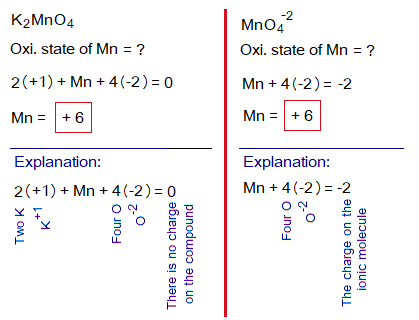
It is easy to measure oxidation state of the transition metal in the compound. The unknown can be determined if the oxidation states of others are known. For example, to find out oxidation state of Mn in K2MnO4, the following mathematical steps are required to do.
Exercise 1:
- Find out oxidation states of Cr and Mn in the compoundsK2Cr2O7 and KMnO4 respectively using mathematical steps; and compare your answers with the oxidation states mentioned above.
- Find out oxidation states of Cr in the ionic molecule (Cr2O7)-2.
Coloured Compounds of Transition Elements:
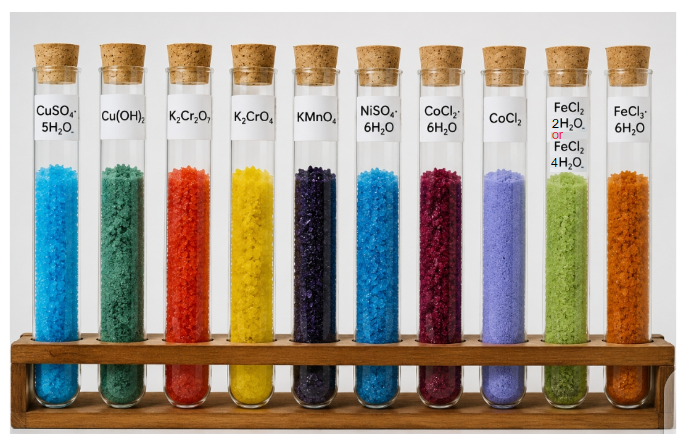
Most of the compounds, the transition metals form, are coloured in their appearance. Few examples are given below:
- Copper(II) sulfate pentahydrate: Its formula is CuSO4.5H2O; is a blue crystalline powder. Commonly known as ‘Neela-Thota’.
- Copper(II) hydroxide: Its formula is Cu(OH)2; is a light blue or a greenish crystalline powder.
- Potassium dichromate: Its formula is K2Cr2O7; is a bright-orange crystalline powder.
- Potassium chromate: Its formula is K2CrO4; is a yellow crystalline powder.
- Potassium permanganate: Its formula is KMnO4; is a dark purple crystalline powder.
- Nickel(II) sulfate hexahydrate: Its formula is NiSO4.6H2O; is a turquoise (bluish-green) crystalline grains.
- Cobalt(II) chloride hexahydrate: Its formula is CoCl2.6H2O; it is a dark rose-red crystalline powder.
- Cobalt(II) chloride dehydrated: Its formula is CoCl2; it is a blue crystalline powder.
- Iron(II) chloride anhydrous: Its formula is FeCl2; it is a tan (beige, light yellowish-brown) crystalline powder.
- Iron(II) chloride dihydrate: Its formula is FeCl2.2H2O; it is pale green solid.
- Iron(II) chloride tetrahydrate: Its formula is FeCl2.4H2O; it is also pale green solid.
- Iron(III) chloride hexahydrate: Its formula is FeCl3.6H2O; is a yellowish-brown or orange crystalline.
- Vanadium(II) chloride: VCl2 is a green solid.
- Vanadyl sulfate: VOSO4 is a blue solid compound. This compound is used as an ingredient in the supplements for bodybuilders. It is also studied due to its insulin sensitivity for diabetic patients.
Transition Elements & Their Compounds as Catalysts:
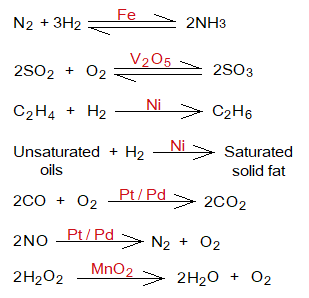
The transition metals or their compounds are used as catalysts in chemical reactions. Few examples are given below:
- Iron: Pure iron metal, Fe, is used in Haber Process for the synthesis of ammonia from nitrogen and hydrogen.
- Vanadium pentoxide: V2O5 is used in Contact Process for the synthesis of sulfuric acid. This catalyst is used for the conversion of sulfur dioxide into sulfur trioxide.
- Nickel: Pure nickel metal, Ni, is used for Hydrogenation of unsaturated organic compounds. Ni is also used for the hydrogenation of edible (vegetable) oils into solid fat (ghee, margarine).
- Platinum & Palladium: Pt or Pd metals are used as Catalytic Converters in exhaust pipes of vehicles to convert harmful gases (Nox, CO) into N2 & CO2.
- Manganese dioxide: MnO2 is used for the Decomposition of hydrogen peroxide into water & oxygen.
The effect of catalysts has been discussed in physical chemical changes rate of the reactions.